
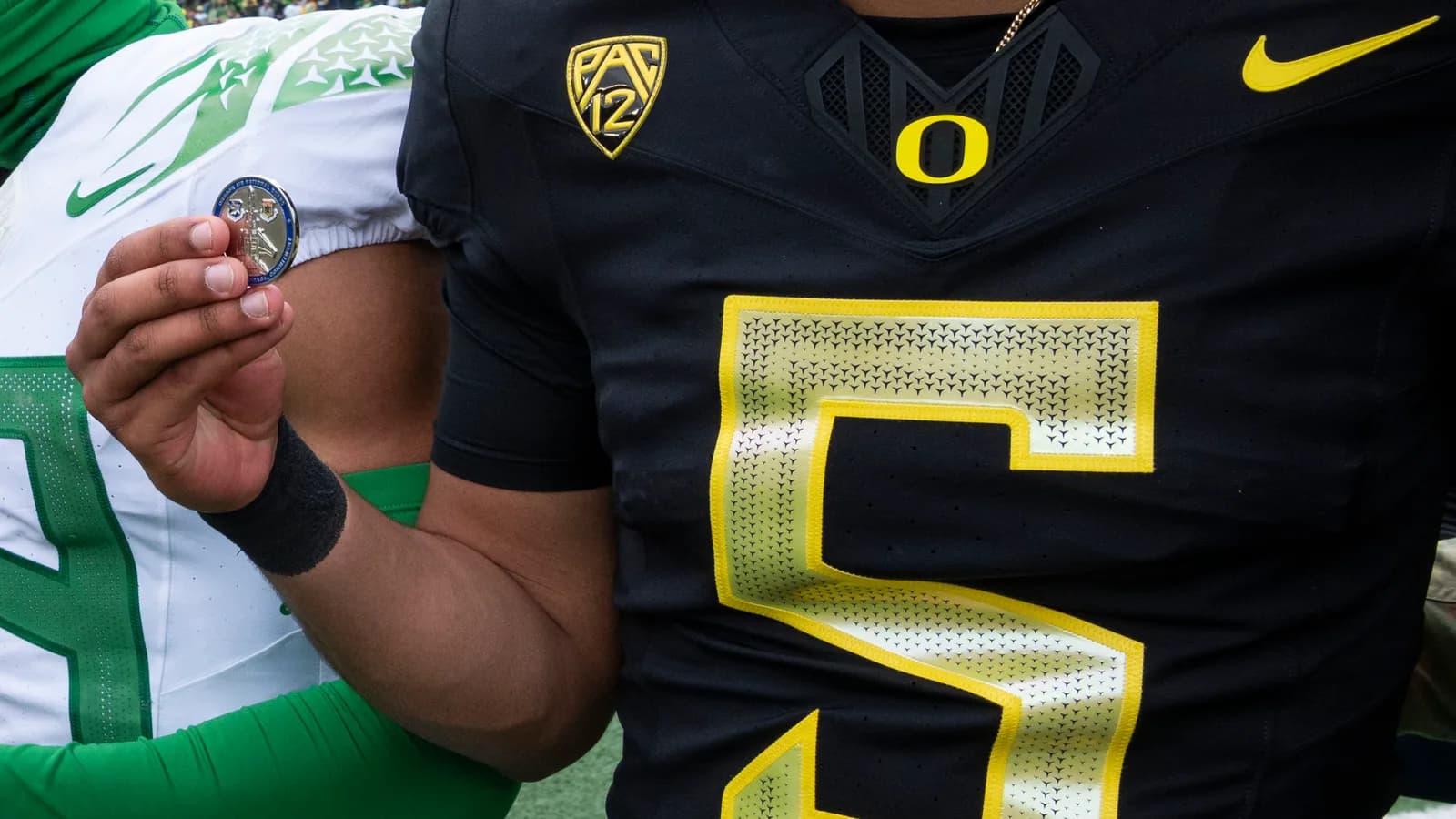
USC linebacker Desman Stephens II hit Dante Moore while the quarterback was sliding in the second quarter Saturday, drew an ejection for targeting, and left Oregon's starter on the ground. Moore was carted off and taken by ambulance to a hospital, and he is in concussion protocol with no return timeline announced, though Oregon expects him back later this season. The Ducks still won 41-27 in Los Angeles, their first Big Ten game of the year. Then the schedule handed them an open date, which means nobody in Eugene plays this week and nobody learns anything new about the quarterback position until Oregon takes the field again.
Dan Lanning did not pretend to have medical answers afterward. He said Moore "is moving, and he does have the ability to move," and spent more energy on the hit itself, calling it "a disgusting play" and saying, "There's a reason targeting exists in football, and it's as clear as day targeting." That is a coach's read, not a diagnosis, and it is all Oregon fans have to go on right now.
What the USC game actually settled
Dylan Raiola's answer was the encouraging part. He came off the bench and went 19-of-25 for 289 yards and two touchdowns, hit Evan Stewart for a 3-yard score on his second offensive snap, and led four second-half touchdown drives. Oregon's offense did not shrink after losing its starter, which matters more than usual given how thin the pass-catching room already was. Jeremiah McClellan, sidelined for multiple weeks with a broken foot, missed the USC game. McClellan had gone through pregame warmups that Portland State night but did not play, and was on the sideline in street clothes with a walking boot and crutches; that one-game question is now closed and replaced by a longer absence.
What filled the gap was Jamari Johnson. The tight end caught seven passes for 119 yards against USC. That is real evidence, not a hopeful projection. It also says something about Drew Mehringer, calling his first Big Ten game as Oregon's offensive coordinator. Lanning credited his route and coverage-matchup designs, and Moore said the offense trusted his calls in two-minute work. On the other side, Lanning credited Chris Hampton's second-half pressures with slowing Madsen after USC moved the ball in the first half. Two promoted coordinators passed their first conference test with a backup quarterback for half of it.
It is also worth remembering how little a single strong result has meant for this team already. Oregon was roughly a 23-point favorite at Oklahoma State and lost 39-31 to a team ending a 21-game FBS losing streak. One road win does not close the season's open arguments.
The defensive front is one of them. Matayo Uiagalelei and Bear Alexander each got a sack at USC, and Oregon held the Trojans to 3.6 yards per carry, but the Trojans still threw for 326 yards. That echoes the opener, when Alexander, Uiagalelei and Teitum Tuioti combined into a front that produced three sacks and seven hurries and held Boise State to 93 net rushing yards. Four games in, this group has flashed without settling anything.
The reason the Moore timeline matters so much is where the schedule goes. Oregon opened at home against Boise State, started Big Ten play at USC, and closes with Ohio State, Michigan, Michigan State and Washington in four straight November games. The open week buys recovery time before that stretch; it does not buy information.
The Big Ten games worth your Saturday
Oregon sits around a 28% playoff chance and a 27% chance of reaching the Big Ten title game. All four of this week's useful results are conference games that shape the standings Oregon has to climb.
Indiana at Rutgers: root for Rutgers
Rutgers is a long shot here.
The one with real weight and almost no chance. Rutgers wins this about 3% of the time. But No. 6 Indiana is the team most likely to occupy the Big Ten title-game spot Oregon wants, and a loss here would put Oregon's chance of reaching Indianapolis near 32% instead of about 26.5% if the Hoosiers take care of it, a 5.5-point swing, by far the largest available. Enjoy it as a longshot, not a plan.
Purdue at Illinois: root for Illinois
Illinois is an 89% favorite at home, and there is nothing exotic here. Another conference loss for Purdue thins the field of teams stacking league wins. Oregon's playoff number lands near 28.3% with the Illini winning versus about 26.1% if Purdue pulls it off, worth 2.3 points.
Maryland at Nebraska: root for Nebraska
The safest of the four. Nebraska wins 94% of the time at home, and the standings effect is the same shape. Oregon's playoff odds sit around 28.2% with a Nebraska win and near 26% if Maryland steals it, a 2.2-point difference. Check the score, don't plan your day around it.
Penn State at Northwestern: root for Northwestern
Northwestern is a 27% home underdog, so this is the one live upset besides Rutgers. A Northwestern win puts Oregon's playoff chance around 29.6%; a Penn State win leaves it near 27.5%. That is 2.1 points, and it also nudges the title-game math, since Penn State is another team Oregon would rather see carrying a loss.
None of it changes what Oregon actually needs, which is a healthy quarterback and a defense that holds up on third and fourth down in November. Full numbers are in the interactive guide, and the methodology explains how the simulation gets there.