
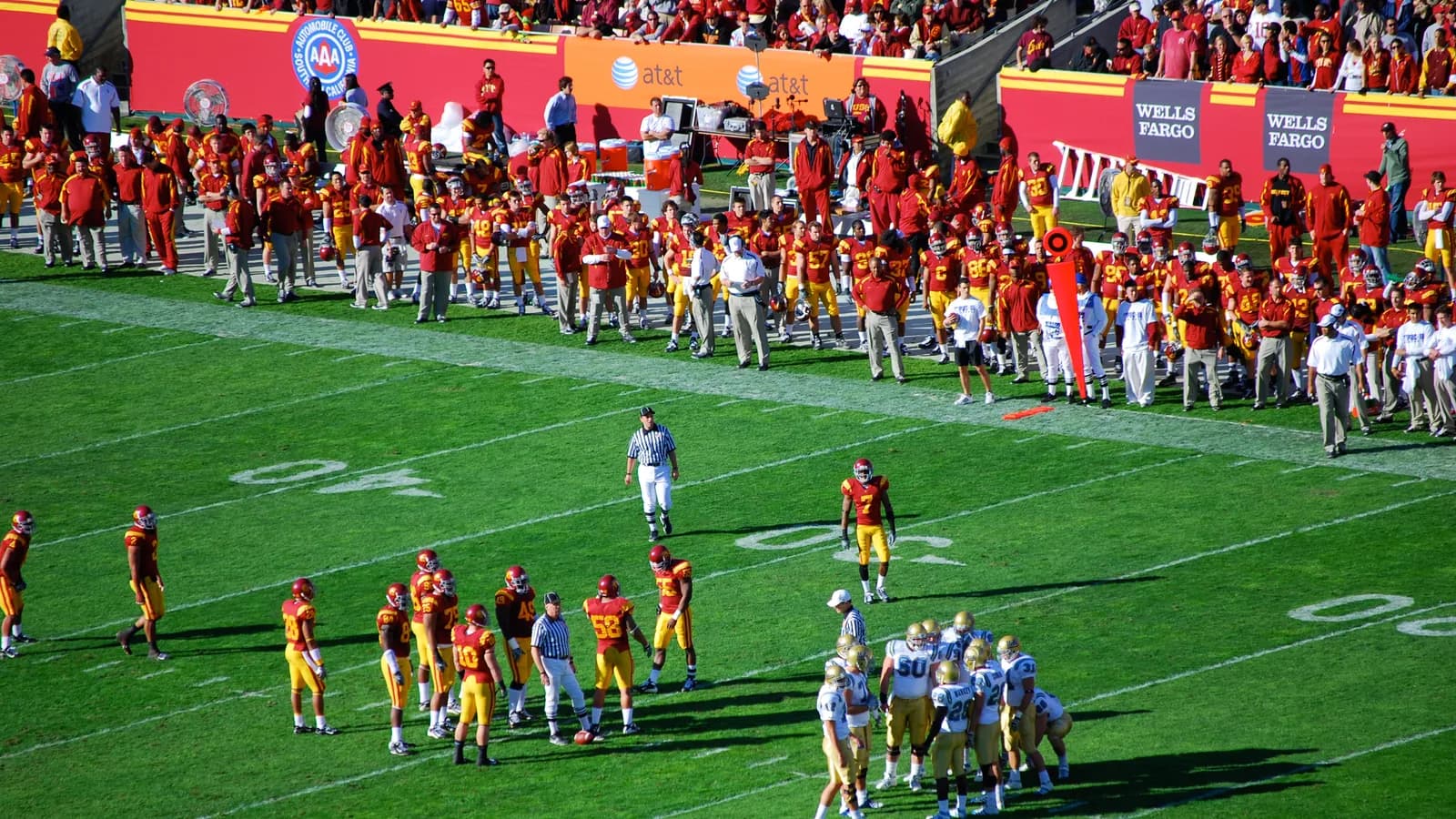
Jide Abasiri stopped San José State on fourth-and-one in the red zone, and Gary Patterson’s starting defense kept the Spartans out of the end zone through three quarters. After USC turned to its backups, San José State generated 23 fourth-quarter points and three consecutive touchdown drives. USC still finished with a 42-26 win.
The starters established that Patterson’s defense can function. The handoff to the next group is now the live issue. Six days later, a run-oriented Fresno State offense gives those reserves a direct chance to show that the fourth quarter was an opening-game lapse rather than the shape of USC’s depth chart.
Fresno State at USC
Friday, Sept. 4, 6 p.m. PT, FOX. USC has an 89% chance to win.
The result itself carries real weight even with USC heavily favored. A win corresponds to a 15.3% playoff branch; a loss corresponds to 8.0%. Those are alternative outcomes from Friday’s game, and they make avoiding the upset much more valuable than chasing style points.
Fresno State averaged 170.5 rushing yards in 2025, and its 2,216 rushing yards were the program’s most since 2014. That recent production gives the Bulldogs a way to challenge USC’s second level without asking the passing game to define the night.
Fresno State must replace its starting quarterback for the second consecutive season and the third time in four years. The quarterback change should make early-down success especially valuable to the Bulldogs, and make USC’s run fits the first place to watch when the defensive rotation begins.
There is also some genuine familiarity here. Matt Entz served as USC’s assistant head coach for defense and linebackers coach in 2024, then went 9-4 and won the Arizona Bowl in his first season leading Fresno State. Entz knows Riley’s program, and Fresno State immediately won under him.
Patterson’s first live USC defense produced one sack and no takeaways. Pressure and takeaways therefore remain available steps forward, but the revealing snaps should come after Patterson starts substituting. Root for the second unit to preserve leverage against the run, tackle without turning routine gains into scoring drives and get off the field without forcing the starters back into heavy work.
The offense has already bought some breathing room
USC does not enter Friday needing to discover whether its reconfigured offense can operate at all. Tobias Raymond made his first career start at center in place of injured Kilian O’Connor; with Raymond in the starting five, USC ran for 164 yards and sustained four touchdown drives of at least 74 yards. That is favorable first evidence that Raymond can absorb the job, even if Fresno State’s front offers another test of protection and communication.
Jayden Maiava completed 25 of 29 passes for 286 yards and two touchdowns without an interception before leaving after three quarters. He did it while USC’s receiver rotation was incomplete. Tanook Hines and Terrell Anderson were unavailable for the opener, and their availability beyond that game remained unresolved as of Sept. 2. True freshman Trent Mosley responded by catching seven of nine targets for 118 yards and a touchdown.
The young receivers gave USC something real to build on, although one productive night without Hines and Anderson cannot settle the eventual hierarchy. Fresno State should apply more pressure to that optimism. Its nine-win 2025 team allowed 18.8 points and 285.7 yards per game while intercepting 20 passes. Root for Maiava and Raymond to keep the operation efficient and protect the ball, allowing the defense, not an offensive repair job, to remain the night’s central story.
The backfield also left room for a more polished encore. Five USC running backs recorded carries in the opener, and the position staff saw missed explosive opportunities and ball-security issues beneath the raw totals. The broad rotation is encouraging for Riley’s pursuit of a more balanced team. Friday can add cleaner execution to that depth without pretending the breakthrough case has already been proved.
The rest of the board
Only two outside results move USC’s modeled playoff outlook enough to deserve space this week, and both require substantial upsets.
Miami at Stanford: root for Stanford
Friday, Sept. 4, 6 p.m. PT, ESPN. Stanford has a 12% chance to win, and the upset is worth +1.4 percentage points in USC’s playoff odds. The Stanford-win branch puts USC at 15.7%; the Miami-win branch puts USC at 14.3%.
This has no Big Ten standings effect. It helps by removing some strength from a national playoff competitor. Because it overlaps USC’s game and remains a long shot, a score alert is enough unless Stanford carries the upset into the second half.
Wisconsin at Notre Dame: root for Wisconsin
Sunday, Sept. 6, 4:30 p.m. PT, NBC. Wisconsin has a 5% chance to win, with an impact of +2.0 percentage points in USC’s playoff odds. A Wisconsin victory produces a 16.4% branch for USC; a Notre Dame victory produces a 14.4% branch.
The mechanism is future-opponent strength. USC visits Wisconsin in Week 8, so a Badgers upset would improve the value of that later matchup. The modeled swing is the larger of the two outside games, but the 5% chance keeps this firmly in fun-if-it-happens territory.
The full slate and conditional branches are available in the interactive USC guide, with details on the simulation at methodology. Friday night belongs to USC’s defensive rotation; everything else is a bonus.