
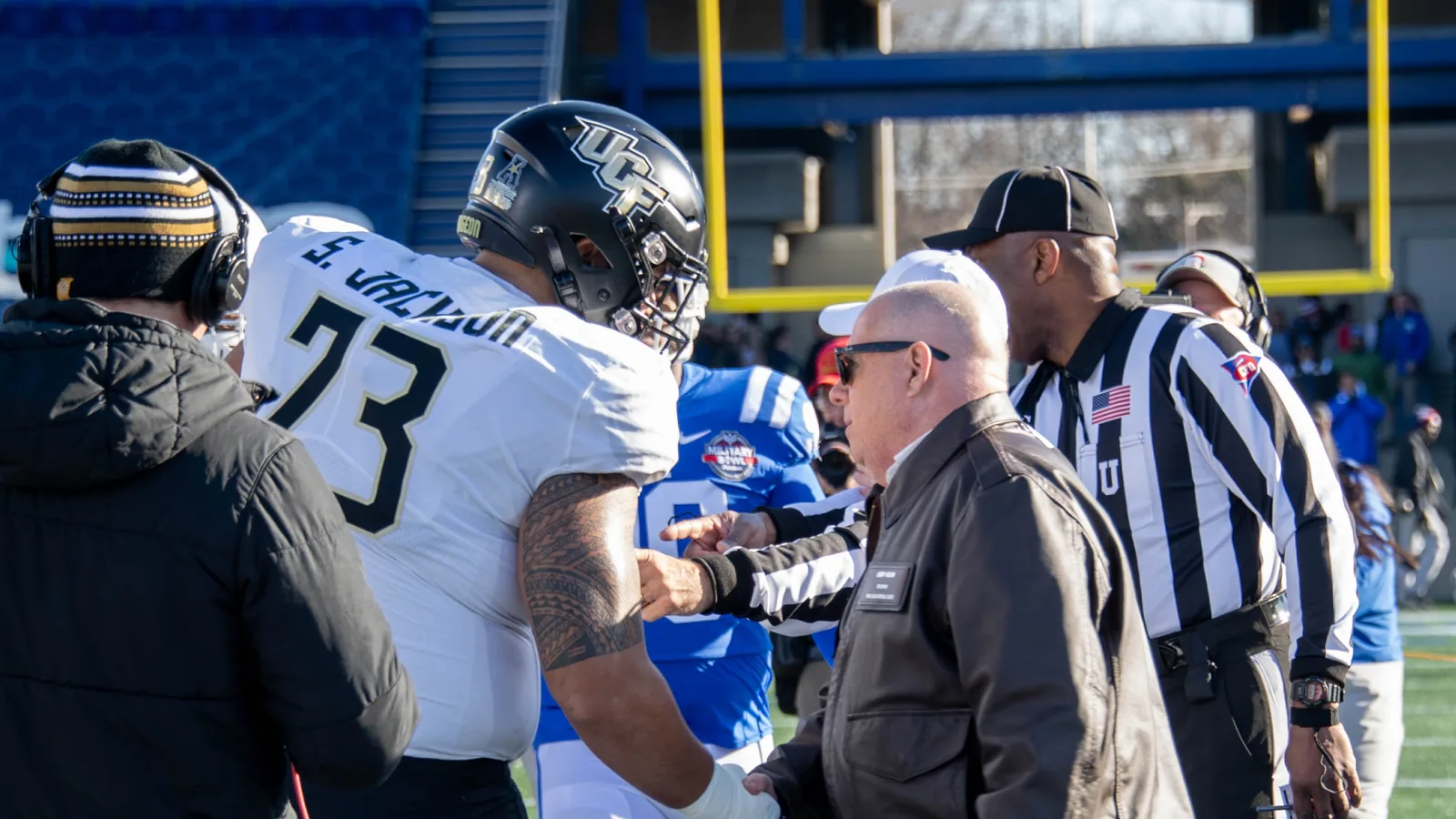
Keyone Jenkins ran in a 5-yard touchdown to put UCF up 17-0 at Houston, and then the Knights never scored again. On UCF's late possessions Houston forced an interception and turnovers on downs, and Frost said afterward that his defense got "gassed" late and that UCF went away from its run game in the fourth quarter for a passing approach that did not sustain drives.
That is the team boarding a plane to Stillwater. UCF lost to Houston 27-17 in Week 5.
What actually broke
The run game is the simplest place to start. UCF rushed for only 73 yards on 21 carries, its second-lowest total of the season, with Duke Watson's 37-yard third-quarter run accounting for about half of it. Frost defended the shift by pointing to RPO reads tied to Houston's box counts rather than a change of heart. It is still unclear whether UCF stopped running or got stopped from running.
Either way, the physical, Watson-centered plan that first won a game for this offense has not shown up since. Watson's career-high 177 rushing yards and two touchdowns against Georgia State came out of a call sheet that was 40 runs to 17 passes, and Frost said at the time that "it was a really good scheme idea by our staff." Three games later, UCF's best version of itself is the one it has recreated the least.
Jenkins, for his part, was not the problem so much as the player asked to do the most. The FIU transfer who had started 32 games and thrown for 6,713 yards before arriving went 7-of-17 for 86 yards in that first UCF start; at Houston he threw 35 times, finishing 23-of-35 for 253 yards with a touchdown, an interception that set up a Houston touchdown, and cramping in the second half. That is a lot of asking from a backup quarterback, and the asking is not going to stop.
Then there is the snap count, which is where the lead actually went. Houston ran 77 plays to UCF's 59. A defense on the field that long against a quarterback who scores with his legs is going to break, and UCF's front gave it no help. The only sack recorded on Weigman all day was a half-sack shared between Aymeric Koumba and J. Culbreath.
The injury list is not cosmetic
UCF went to Houston already missing four starters, Barnett, receiver Duane Thomas Jr., guard Owen Spell and linebacker Lewis Carter, and left with two more. Center Jacob Maiava went down with a hip injury, and his replacements Cooper Terpstra and Conner Meadows had off-target snaps that were cited as contributing to the pressure on Jenkins. Jayden Jennings, who was already filling in for Carter, left with an arm injury and went into a sling.
Barnett has been out since an injury in Week 2, with Jenkins starting in his place. If Barnett is in uniform Saturday, that is the single biggest piece of news of UCF's season so far. The dual-threat quarterback UCF built this offense around has one unflattering Power Four game on his record and nothing since. If he is not, Jenkins carries a thinner roster into a hostile stadium again.
Why Stillwater is the specific problem
The market treats this as a comfortable Oklahoma State home game. The Cowboys opened as roughly a 9.5-to-10-point favorite, with one model putting them at 77.1% to win. Our simulation is friendlier to UCF, about 60%, which is a real disagreement rather than a rounding difference; the model likes UCF's underlying team strength more than the betting line does. Pick whichever you find more credible, but note that UCF was a 3.5-point underdog to TCU in Orlando.
A win nudges UCF's Big 12 championship-game chances to roughly 1.4%, a loss leaves them near 0.1%. Full Big 12 scenarios are in the interactive guide, and how these numbers work explains the forecasts.
The part UCF can control is the part that got away in Houston. Watch UCF's first three drives of the second half. Watch whether the Knights are still handing the ball off while ahead. Watch the third-down snap count on the defense. If UCF is leading at the end of the third quarter in Stillwater and still running the ball, the rest of October looks very different than it did Saturday afternoon.