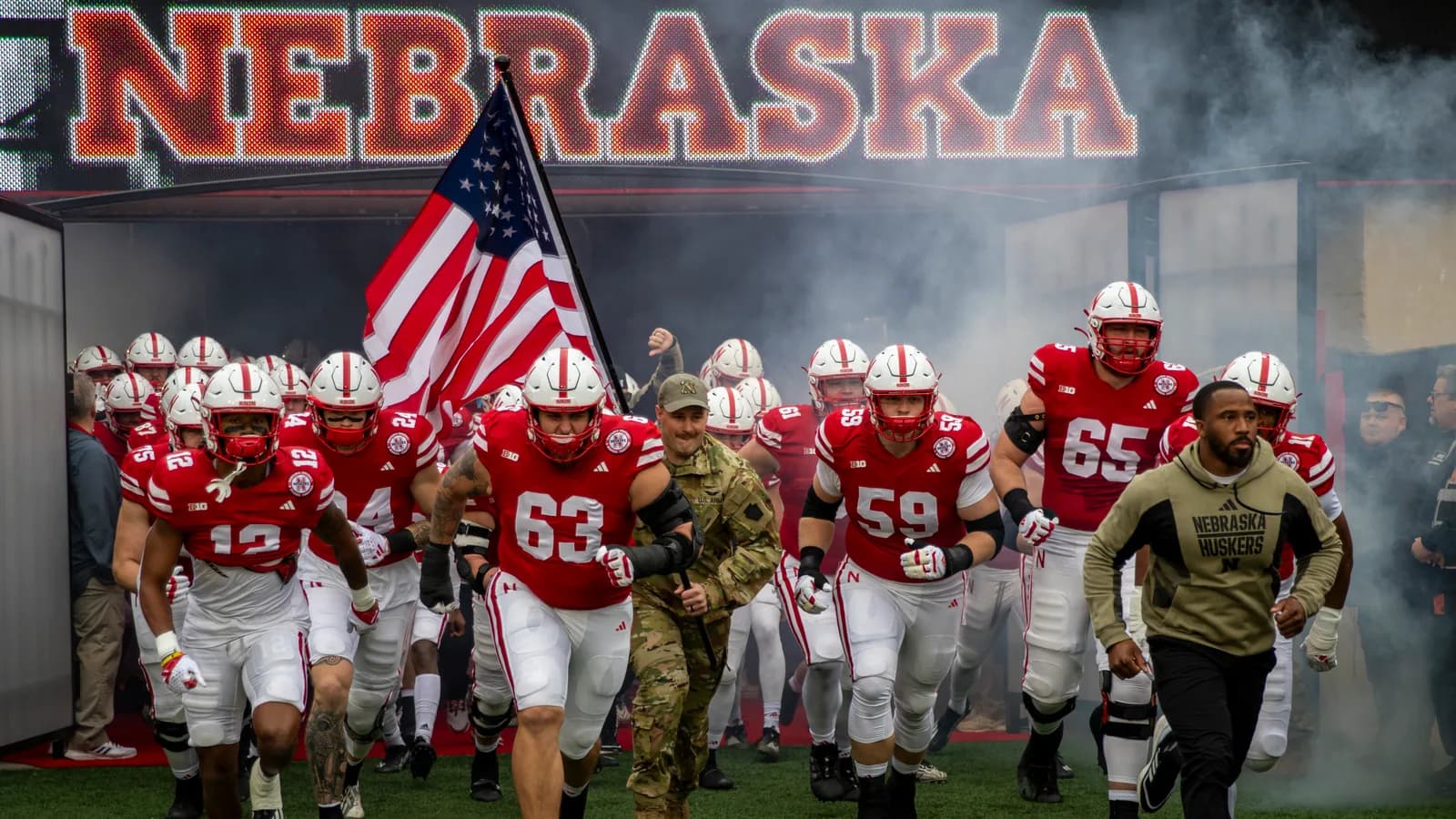
Jamal Rule took Nebraska's first offensive snap of the second half 55 yards for a touchdown to make it 24-0 on the way to a 34-7 win over North Dakota. The true freshman finished with 15 carries for 119 yards and two scores, his second 100-yard game of the season. Nebraska had already scored on its first two possessions for a 14-0 first-quarter lead, and it closed the night with 277 rushing yards on 45 carries and 493 total yards to North Dakota's 205.
That is how Nebraska got to 3-0, and it is the formula that now goes on the road. The Huskers play at Michigan State on Saturday at 4 p.m. CT on BTN, and Spartan Stadium has not been kind. Michigan State won the last two meetings there by three points each, in 2021 in overtime and again in 2023, and Nebraska's only win in East Lansing in this series came in 2012, a 28-24 comeback. The simulation gives Nebraska a 62.9% chance, and the betting market agrees in spirit. Nebraska opened as roughly a 4.5-point favorite, making Michigan State a home underdog in its Big Ten opener.
The backfield question has an answer, and it's a freshman
Emmett Johnson is gone, and for three weeks the honest response to "who replaces him" was "a committee." Against North Dakota that committee finally had a shape. Rule played 32 snaps, Mekhi Nelson 16 and Isaiah Mozee 15, and all three cleared 40 rushing yards. Rule is averaging 109.7 rushing yards per game, and his six total touchdowns are the most by a Husker through three games since 2011, part of a start in which the Huskers rank top-12 nationally in scoring, rushing and total offense and top-16 nationally in scoring, passing and total defense while outscoring three nonconference opponents by a combined 104 points.
None of those numbers were earned against a Big Ten front. Michigan State's defense is the first one that can make Nebraska's rebuilt line win on downs where everyone in the stadium knows a run is coming. Watch first down. If Rule is getting four and five yards into a loaded box, Nebraska controls the afternoon the way it controlled September. If the committee is running into unblocked bodies, Colandrea has to win the game with his arm, which is not what the first three weeks suggested he would be asked to do.
The passing game has been a supporting act, by the quarterback's own account
Anthony Colandrea has been efficient and turnover-free for three straight weeks, and he still described the North Dakota night as "kind of a little shaky," adding that Nebraska could "clean that up by watching film." That is a quarterback noticing that one passing touchdown is not three. The protection evidence is similarly incomplete. Nebraska's offensive linemen were charged with no pressures, quarterback hits or sacks against North Dakota, a genuinely clean night, but one that came two weeks after Matt Rhule praised Colandrea's accuracy and said he was more disappointed with parts of the pass protection, singling out a Bowling Green defender who affected Nebraska too often. A Big Ten edge rush is the tiebreaker between those two data points.
Nebraska will handle that edge rush without tight end Carter Nelson, who was hurt late against North Dakota and will not play Saturday. Rhule said the injury is not ACL-related but that Nelson's status beyond this week is unknown, and called it Nebraska's only significant injury entering conference play.
Rob Aurich's defense, and the hidden yardage
Rob Aurich is in his first year running Nebraska's defense after his 2025 San Diego State unit allowed 12.6 points and 266.7 yards per game, fifth and seventh nationally. The install has looked like it's taking. Against a North Dakota team ranked No. 6 in the FCS and averaging about 50 points a game, Nebraska allowed 205 yards and 10 first downs, held the Fighting Hawks to 1-of-12 on third down and sacked Jerry Kaminski five times. Third down on the road is where that shows up or doesn't. Spartan Stadium is loud; a defense that gets off the field lets Nebraska keep handing the ball to Rule.
The unresolved piece is special teams, and in a building where the last two games were decided by three points, it is the piece most likely to matter. Against Bowling Green, Nebraska took seven accepted penalties for 65 yards, three of them holding calls on punt returns by Mario Buford, Braylen Prude and Derek Wacker, with Rhule accepting responsibility for adapting Nebraska's aggressive special-teams coaching to how it's being officiated. Week 3 did not settle it. One account had another good punt return wiped out by holding "yet again," alongside a missed 54-yard field goal; another credited the unit with fewer penalties and a clean Jacory Barney return. Erasing a 20-yard return against an FCS team costs nothing. Erasing one in a one-score road game costs a possession's worth of field position.
What a win is actually worth
Nebraska beat Michigan State 38-27 in Lincoln last October, leading 14-0 after a quarter, watching the Spartans pull even at 21-21 through three, then closing on a 17-6 fourth-quarter run. That game is the template both for what Nebraska can do and for how quickly this opponent erases a lead.
The playoff math is honest about where Nebraska stands. A win leaves the Huskers around 7.3% to reach the College Football Playoff; a loss drops that to roughly 2.8%. Neither branch is a season. What a win buys is a 4-0 start with Maryland next at home, and the first real evidence that the run game, the line and Aurich's front travel. That is worth a Saturday afternoon on its own, and it's the only game this week that asks Nebraska fans for anything.
Full odds and the week's numbers are at the interactive guide; the model is explained at methodology.