
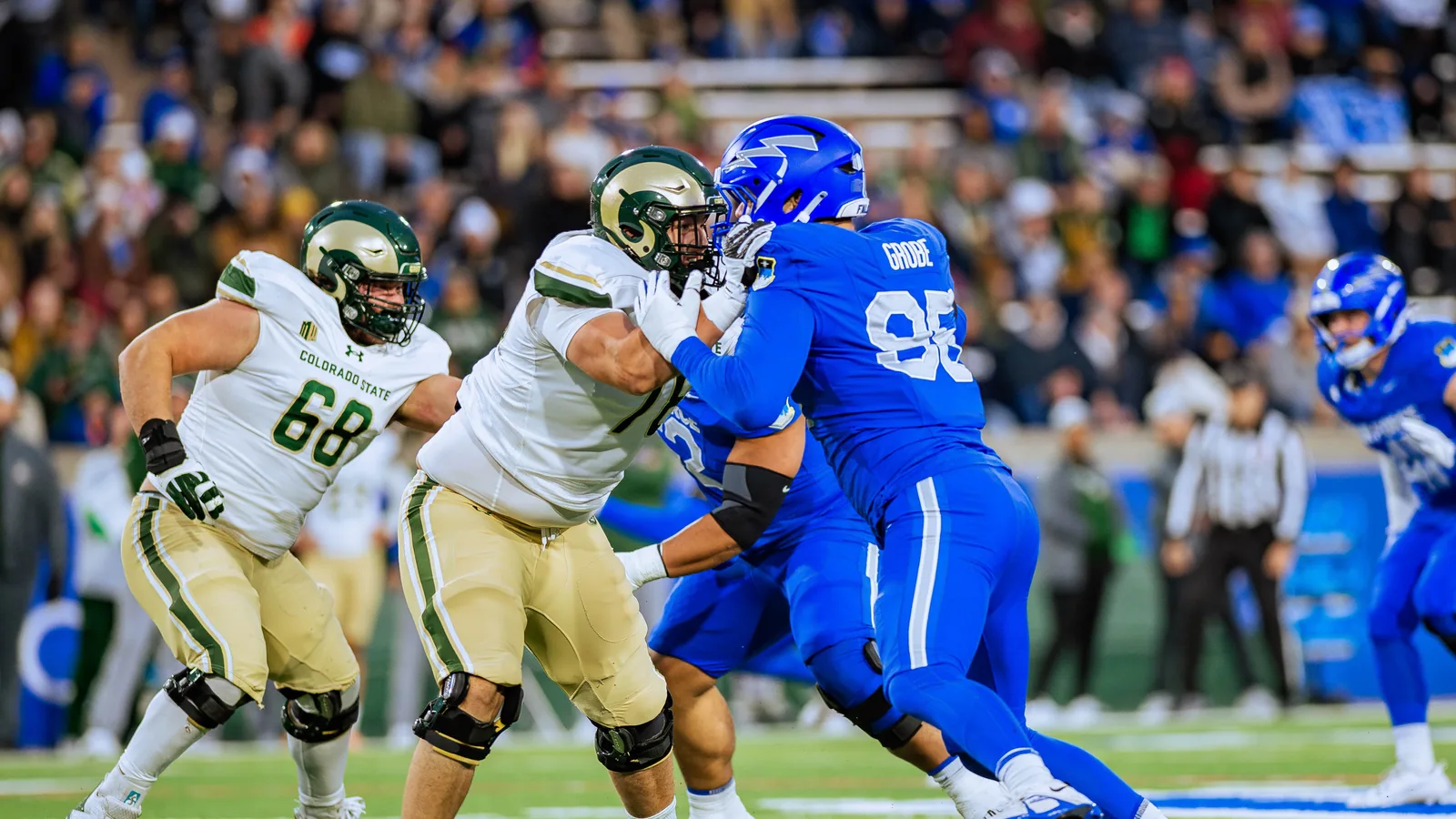
At Canvas Stadium, LJ Martin ran for 173 yards in the first half on 14 carries, 176 and three scores for the day, part of 332 rushing yards at 8.1 a carry. Colorado State intercepted two passes and still got outgained 559-302 in a 41-23 loss. Mora's verdict afterward was blunt. "We gave up over 300 yards rushing, which is not OK, and we didn't run the ball well." He also said stopping big plays has been "a real, real, real, big, big, big, big problem for us defensively."
That is the number that travels badly. Southern Utah alone piled up 206 rushing yards against this defense, which isn't a unit finding itself, it's a unit sliding. And Saturday the Rams go to the Alamodome to play UTSA, which a year ago ran Robert Henry Jr. for 144 yards on 21 carries against them, including a 76-yard touchdown, before Owen McCown hit Henry for a 74-yard touchdown with 4:49 left to win 17-16. The profile that just wrecked CSU is the profile waiting in San Antonio.
The offense that was supposed to cover for this
Colorado State was built to hide the defense. Offensive coordinator Tracy defined the new offense as run-first, leaning on the backs, tight ends and offensive line to control games, the whole point being to shorten them and keep an inexperienced quarterback out of trouble. Against BYU that plan produced 82 team rushing yards.
Now the quarterback himself is in doubt. Hauss Hejny left in the first quarter with a hamstring injury after going 6 of 10 for 80 yards and a touchdown, and Mora has called him a likely game-time decision. "Our hope is that he can play. If he can't play, then K'saan (Farrar) and Darius (Curry) will be ready to go." Mora added that if Hejny plays he has to be able to protect himself and still do the things that make him special, which, for a quarterback whose value includes his legs, is not a small condition. Farrar's own status is uncertain after he was poked in the eye late against BYU.
What the backups did last week is the honest preview. Farrar went 13 of 23 for 70 yards with an interception. Curry came on and went 6 of 8 for 70 yards with a 1-yard touchdown to Chirchi. If the Rams are asking a third-stringer to run a run-first offense against a defense that does not have to respect the deep ball, the defense is going to be on the field a long time.
What Saturday is worth
This is Colorado State's first true road game of the season after three straight at home, and the model gives the Rams about a 19% chance to win it. UTSA opened as an 11.5-point favorite, so the market sees roughly the same game. Kickoff is noon Eastern on ESPNU.
A 19% underdog is not something to build a week around, but it is a real number, and the series argues for it. CSU won 33-31 at the Alamodome in 2015 and 23-14 in 2016, and UTSA won 17-16 in Fort Collins last September, with the 2015 and 2025 meetings each decided by one score. Nothing in this matchup has ever been decisive.
So watch first downs on the ground. If CSU's front holds Henry under five yards a carry and forces UTSA into obvious passing situations, the rest of it, whoever is at quarterback, whatever the offense can sustain, stays playable into the fourth quarter. If Henry is ripping off 20-yard runs in the first half the way Martin did, this ends the way the BYU game ended, and the Rams walk into their Pac-12 opener against Oregon State having learned nothing good about the run defense Mora most needs to fix.
Mora said BYU was "what we're striving to be" and that the loss was "a program performance," language that puts the blame on the whole operation rather than the players who happened to miss tackles. It also puts a real edge on this trip. Colorado State reached 2-0 for the first time since 2011. Nobody outside the program knows yet whether it travels, and this is the week that starts to answer it, not with a win necessarily, but with a defense that makes UTSA work for what it gets.
Full game details are in the interactive guide, and the forecasting approach is explained in the methodology.