
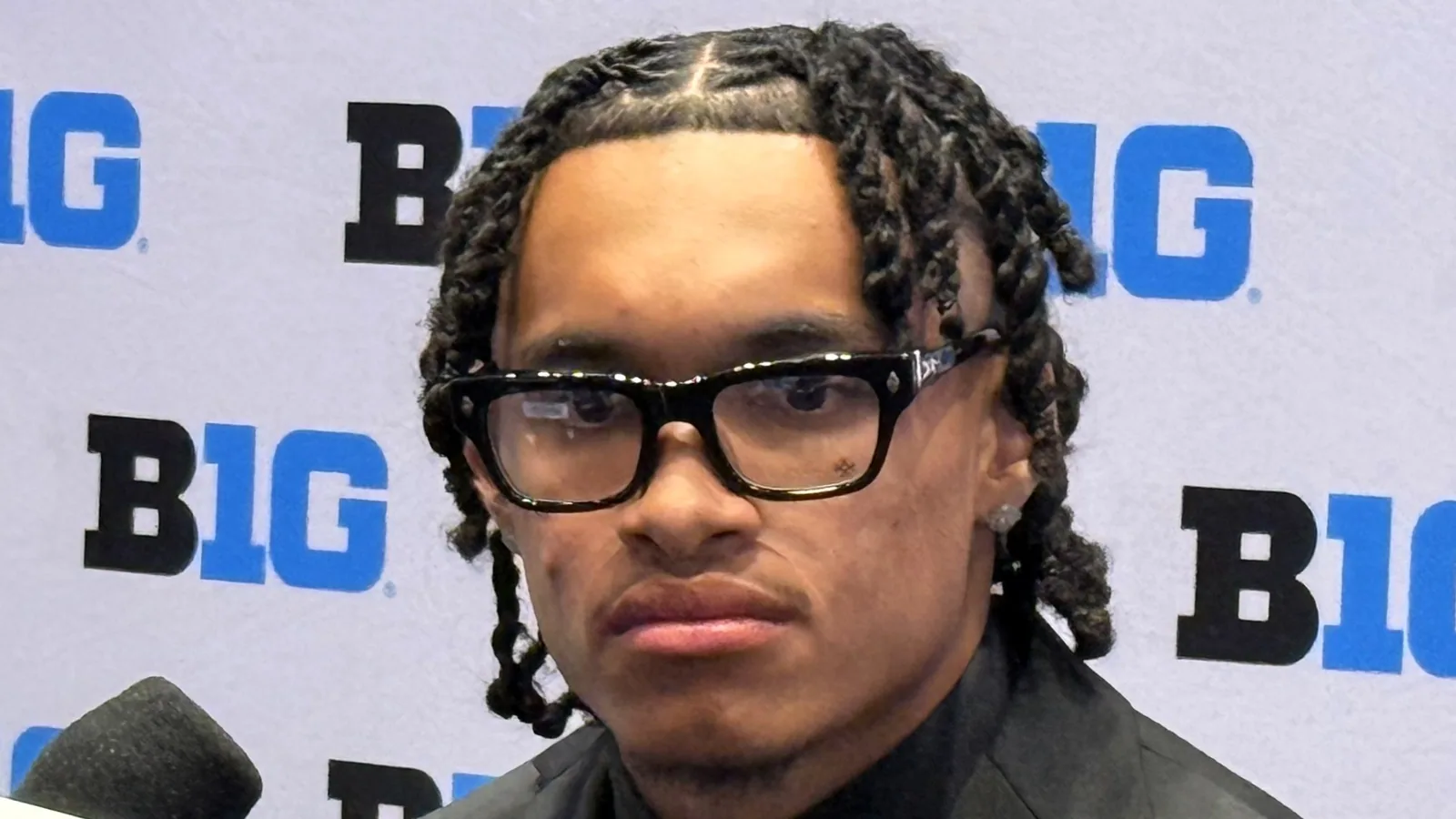
Demond Williams Jr. completed all six of his fourth-quarter passes for 115 yards, then escaped on third-and-9 for a pivotal 21-yard scramble. Those late plays helped Washington beat Washington State 24-10 in the Apple Cup, giving the Huskies a win after an uneven offensive start rather than pretending the unevenness never happened.
Williams finished with 268 passing yards, 61 rushing yards and no turnovers or sacks. That is an encouraging first answer to the biggest offensive question of Jedd Fisch’s coordinator-less setup, especially after Washington committed 12 penalties and scored on only four of six red-zone trips. Williams can steady the operation; now Fisch needs to find out who can reliably help him.
Washington’s new committee gets a live audition
Washington hosts Utah State at 12:30 p.m. Pacific on Saturday on BTN. The simulation gives the Huskies a 93% chance to win. The model gives Washington a 14.9% playoff chance with a win and 7.8% with a loss, enough separation for the result to matter even if the matchup should not be suspenseful.
The more revealing part should happen behind Williams. Quaid Carr gained 28 yards on five carries before leaving the opener, while Jayden Limar supplied 47 yards and a touchdown on 12 attempts. Trey Cooley managed one net yard on four carries. Carr and Limar are now expected to miss extended time, with Carr needing hand surgery and Limar dealing with an elbow injury; Fisch said Cooley and freshman Brian Bonner Jr. will share the primary work, with Ansu Sanoe also expected to contribute.
Beyond the expected final score, watch whether Washington can establish a real division of labor in the backfield. Can Cooley turn ordinary carries into dependable gains? Can Bonner handle meaningful snaps without forcing Williams to become the running game? Can Sanoe give the rotation enough depth to remain functional? Carr and Limar had barely begun defining their roles before the offense had to start over.
The uncertainty extends beyond running back. Starting receiver Christian Moss left after two offensive snaps with a soft-tissue injury, and Fisch supplied no timetable for his return. Chris Lawson’s four catches for 87 yards, Rashid Williams’ three for 74 yards and a touchdown, and Dezmen Roebuck’s seven for 41 showed that the rebuilt receiving group can spread production around. Moss’s uncertain availability makes that distribution a necessity rather than a pleasant opening-week detail.
Utah State offers Washington room to experiment, but not permission to drift. The Aggies lost 29-17 to Idaho State despite producing 407 yards and 29 first downs; four interceptions, three failed fourth downs and 11 penalties repeatedly erased their movement. Washington should attack that instability, though fans should care as much about sustained stops as another convenient pile of turnovers.
The defense has earned that expectation. Washington generated three sacks, eight tackles for loss and three takeaways in the Apple Cup. Emmanuel Karnley contributed five tackles and two pass breakups, Dylan Robinson made four tackles, and freshman nickel Jeron Jones returned an interception nine yards. Those were useful first contributions from the new corner configuration, but Utah State’s yardage makes Saturday another chance to show the secondary can control possessions before mistakes end them.
That performance also looked like a continuation of Ryan Walters’ 2025 defense, which allowed 18.7 points and 100.2 rushing yards per game and let no opponent score more than 26. The best version of Saturday is therefore fairly specific. The front keeps Utah State behind schedule, the corners prevent easy recovery throws, and the offense builds its new rushing rotation without asking Williams to rescue another slow start.
This is the second of four consecutive September home games before Washington travels to USC. That stretch matters because the program is still trying to turn a rebound into something durable. Washington went from 14-1 and a national-title-game appearance after the 2023 season to 6-7 in 2024, then recovered to 9-4 in 2025. Beating Utah State will not establish another contender. Using the expected win to make Cooley, Bonner and the reconstructed supporting cast more trustworthy would move the Huskies in that direction.
Mississippi State at Minnesota: root for Minnesota
Kickoff is also at 12:30 p.m. Pacific Saturday on CBS. Minnesota has a 51% chance to deliver the preferred result, so this is essentially a coin flip worth noticing rather than arranging the afternoon around.
The mechanism is straightforward. Washington plays Minnesota in Week 4, and a Gophers win would strengthen the value of that future opponent. The model values a Huskies win in Week 4 more if the Gophers arrive with this victory. Washington’s playoff chance is 15.1% if Minnesota wins and 13.8% if Mississippi State wins, a difference of 1.3 percentage points. Root for Minnesota, but save the real attention for whether Washington’s new backfield begins to look usable.
See every modeled branch in the interactive Washington guide, with the simulation approach explained in the methodology.