
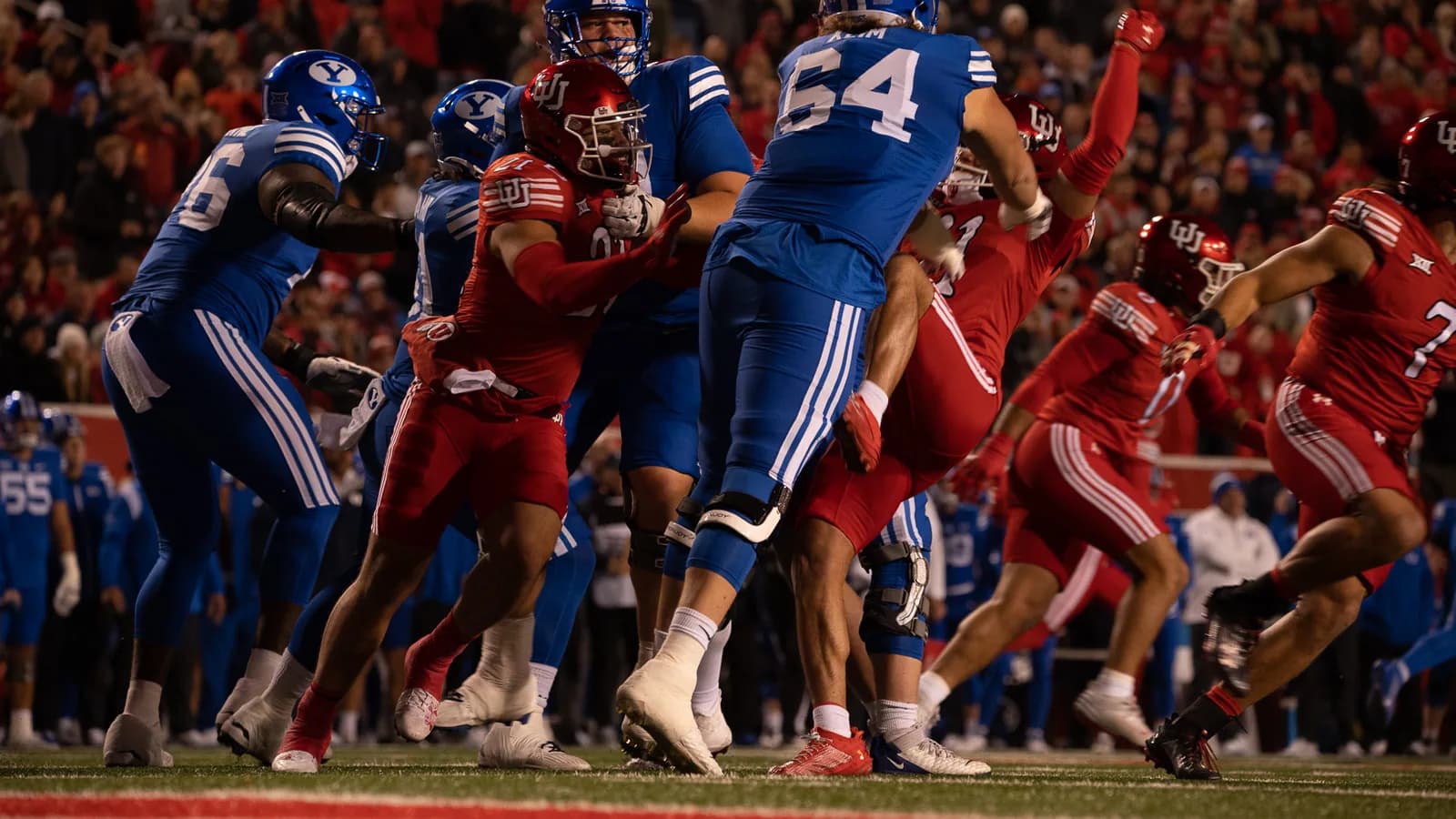
Morgan Scalley reviewed the Idaho film and found the blemish inside Utah’s 66-14 win. Devon Dampier took too many early hits. The Utes still allowed no sacks, rushed for 364 net yards on 49 attempts and grew more cohesive up front as the game went along, but Scalley continued rotating guards and had not yet settled on his preferred five.
Utah’s entirely rebuilt offensive line handled Idaho, but Arkansas should make the group protect Dampier and sustain Kevin McGiven’s offense through more resistance.
Utah hosts Arkansas at 8:15 p.m. Mountain on Saturday, Sept. 12, on ESPN. The Fan Watch model gives the Utes an 88% chance to win, so this should feel more like a game Utah controls than a coin flip. A win lifts Utah’s modeled CFP chance to 39%, while a loss leaves it at 31%. That eight-point gap is the modeled difference between winning and losing Saturday.
Watch the hits, not merely the rushing total
Zereoue Williams, Solatoa Moea’i, Alex Harrison, Roger Alderman and Cedric Jefferson made up Utah’s first starting line, while expected starter Keith Olson did not play and no reason was publicly established. The productive final numbers matter, but so does the unfinished guard competition. Arkansas can reveal whether Utah’s run-game timing survives early disruption and whether Dampier can work through a full game without the unnecessary contact Scalley saw against Idaho.
That protection matters because McGiven showed far more than a standard quarterback rotation in the opener. Dampier pitched to Byrd Ficklin for nine yards; Ficklin also aligned at receiver and later took a pitch before attempting a downfield pass. McGiven mixed in heavy tight-end formations and handed the ball directly to Hunter Andrews for 13 yards. Arkansas now has to defend Dampier and Ficklin as simultaneous threats rather than wait for one quarterback to replace the other.
The quarterbacks gave those ideas credibility. Dampier completed 13 of 18 passes for 176 yards and three touchdowns, then added 31 rushing yards. Ficklin threw two touchdown passes and ran eight times for 70 yards. Neither quarterback threw an interception or took a sack. Against Idaho, the designs were clever and the execution was clean; this week, Utah fans should watch whether pressure forces McGiven to simplify them.
Arkansas at least supplied a reason to take that question seriously. The Razorbacks held North Alabama to 40 rushing yards, recorded two sacks and allowed one third-down conversion in 10 attempts. That came against another FCS opponent, so it does not establish that Arkansas can shut down Utah. It does give the rebuilt line a more relevant problem than the final margin alone suggests.
Utah dispatched an overmatched Idaho team without an opening-week scare, but beating an FCS opponent says little about whether the Utes can win the Big 12. Arkansas is still a game Utah is heavily favored to win; the added value is seeing whether the offense can preserve its balance when the first plan meets resistance.
Scalley’s delegation gets a longer look
The opener also gave Utah fans an encouraging first picture of Scalley as the person running the entire program. Dampier credited his calm energy and his instruction to move past mistakes, while Scalley credited coordinators Colton Swan and McGiven for their game plans. Swan called pressure from multiple angles with the autonomy Scalley had promised, and Utah finished with one accepted penalty for 10 yards.
That is meaningful after an internal succession, but a rout cannot show how the arrangement works through prolonged stress. Against Arkansas, pay attention to whether McGiven keeps his variety after a negative play and whether Swan can create disruption without exposing a defense still establishing new starters.
Utah opened with Elijah Davis and Elijah Reed at corner, Ethan Day and Lance Holtzclaw at end, and Karson Kaufusi and Jireh Moe at tackle. Kaufusi produced the defense’s only sack, and Scalley praised Kaufusi, Moe and Holtzclaw after reviewing the game. Those players are no longer abstract replacements; Arkansas gives them another chance to turn encouraging individual snaps into steady front-line production.
Swan’s defense held Idaho to 225 yards and three third-down conversions in 13 tries, but Utah finished with only one sack and four tackles for loss. Idaho also assembled two 75-yard touchdown drives. The takeaways made the debut look emphatic, while those long drives kept the defensive picture mixed.
The sequence that broke the opener open is worth wanting again. Trey Reynolds intercepted Joshua Wood on Idaho’s first possession, Rabbit Evans recovered a fumble on the next, and Utah converted the two short fields into 10 points. The offense then proved it did not require gifts by completing eight touchdown drives ranging from 44 to 87 yards.
Arkansas arrives with an obvious vulnerability in that exchange. The Razorbacks committed three turnovers against North Alabama, an interception and lost fumble by KJ Jackson, plus a lost fumble by Sutton Smith, and produced only one takeaway. Utah does not need turnovers to justify its status as the favorite, but another early one would let McGiven dictate personnel and tempo instead of asking the unsettled line to chase the game.
No other result needs Utah fans’ attention this week. At Rice-Eccles, watch whether the five new linemen keep Dampier clean and whether McGiven retains the two-quarterback variety that made the opener interesting. The interactive guide has the full modeled outlook, and the methodology explains how the percentages are produced. The best version of Saturday is not merely another comfortable final score; it is Utah reaching that score without having to abandon the offense it wants to become.