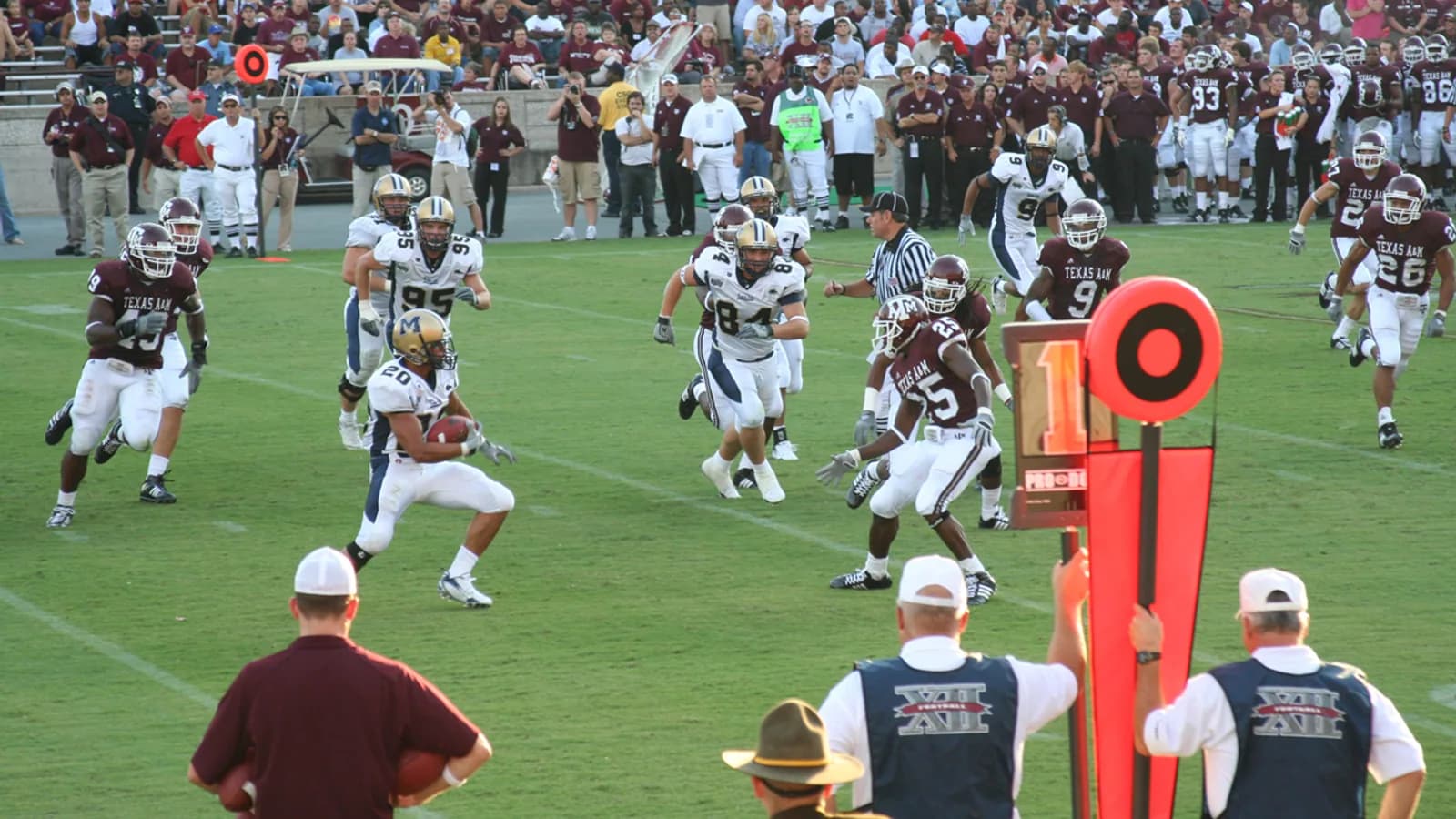
Texas A&M beat Missouri State 50-0, but the rebuilt lines were not equally convincing. Ryan Henderson supplied A&M’s only sack and forced a fumble, while Missouri State dropped Marcel Reed on consecutive first-half plays. Arizona State can test whether the defensive front creates pressure against a dangerous passing game and whether the offensive line’s early protection problems are actually fixed.
The Aggies ran 85 offensive plays to Missouri State’s 40 and possessed the ball for 43:03. After losing a second-quarter fumble, they scored on each of their next seven meaningful possessions. Holmon Wiggins’ first game calling the offense ultimately produced 505 yards and seven scores in eight red-zone trips, while Lyle Hemphill’s defense held Missouri State to 67 yards and one third-down conversion in 10 attempts. Those are excellent first returns, but the opponent and the offense’s early sacks, penalties, drops and fumble keep them from settling anything.
Arizona State can attack the unfinished work
No. 10 Texas A&M hosts Arizona State at 11 a.m. Central on Saturday on ABC. The Fan Watch model gives the Aggies an 88% chance to win, making this less about identifying the preferred result than watching whether A&M controls the line of scrimmage from the opening series.
Cutter Boley threw for 387 yards and six touchdowns without an interception in Arizona State’s 70-7 opening win over Morgan State. Reed Harris, Grayson Rigdon and Omarion Miller each cleared 100 receiving yards as the Sun Devils averaged 9.6 yards per play. The jump in opposition cuts both ways, but Arizona State at least arrives equipped to challenge Hemphill’s secondary and force the new defensive front to affect a quarterback before vertical routes develop.
That front spread six tackles for loss among six Aggies against Missouri State. Henderson had two, including the lone sack, while Tamarion Watkins, Tristian Givens and Samu Moala each recorded one. A&M needs more than another low yardage total Saturday; it needs Henderson and company to compress Boley’s time without opening escape lanes or leaving the back end to survive extended coverage.
That matters because Hemphill inherited an unusually high standard. Texas A&M led the nation in third-down defense in 2025, ranked second nationally in sacks per game and ranked third nationally in tackles for loss per game. The Missouri State performance suggested the disruptive identity survived the coordinator change. If A&M can hurry Boley and get off the field against Arizona State’s explosive passing game, Hemphill will have a more meaningful sign that the 2025 standard carried over.
The offensive line has the more immediate correction to make. Blake Ivy, Mark Nabou Jr., Tyree Adams, Wilkin Formby and Trovon Baugh started the opener, and Missouri State recorded consecutive first-half sacks. Reed said communication and pressure pass-offs improved after adjustments, while A&M’s rushing output rose from 76 first-half yards to 160 after halftime. Arizona State should tell fans whether that improvement traveled from the sideline into the next opening series.
The cleanest version of Saturday is not Reed repeatedly escaping trouble and turning broken plays into offense. It is Wiggins getting the protection organized early enough to use the stability A&M already has at quarterback and receiver. Reed completed 21 of 30 passes for 233 yards, two touchdowns and no interceptions against Missouri State, and ten Aggies caught at least one pass. That distribution supports the idea that the offense can remain productive under a new play-caller; the rebuilt line must let it begin on schedule.
Personnel availability could affect the defensive side of that equation. Mike Elko said after the opener that Daymion Sanford had been held out because he probably needed another week and that Tawfiq Byard was expected back soon after a lower-body practice issue; Elko also said Madden Williams would miss the season and undergo surgery after a lower-body injury. Those comments did not guarantee Sanford or Byard for Saturday, so their status bears watching before kickoff.
An A&M win produces a 43.6% playoff branch in the simulation, compared with 29.1% after an Arizona State win. The corresponding SEC title-game branches are 22.7% and 19.4%, and the first-round-bye branches are 12.9% and 7.4%. This is a nonconference game, so it cannot change the SEC standings directly. It can preserve A&M’s national margin for error and, more importantly this week, show whether both lines can function cleanly before Kentucky brings conference consequences seven days later.
The rest of the board
Penn State at Temple: root for Temple
Kickoff is 11 a.m. Central on ESPN2. Temple has only a 6% chance to spring the upset, but doing so would remove a prominent competitor from the unbeaten national pool. A Temple win corresponds to a 44.1% A&M playoff branch; a Penn State win corresponds to 41.7%, a 2.4-percentage-point difference.
A Temple upset would help, but the 6% probability and modest projected swing make it a score-check rather than a game A&M fans need to follow closely.
Alabama at Kentucky: root for Kentucky
Kickoff is 2:30 p.m. Central on ABC. Kentucky has a 19% chance to win, and the direct SEC mechanism makes this the more relevant outside game. An Alabama conference loss would put A&M’s title-game branch at 24.2%; an Alabama win would put it at 21.8%, a 2.3-percentage-point difference.
Kentucky winning would be useful even though the Wildcats visit College Station next week. A&M would still control its own meeting with Kentucky, while Alabama would already own an SEC loss. Root for the upset, then let the Aggies deal with Kentucky themselves.
The full set of conditional outcomes is in the interactive Week 2 guide, with the simulation approach explained on the methodology page. Saturday should remain centered on A&M. Make Boley hold the ball, keep Reed upright from the opening series and turn Week 1’s dominance into evidence that will matter in SEC play.