
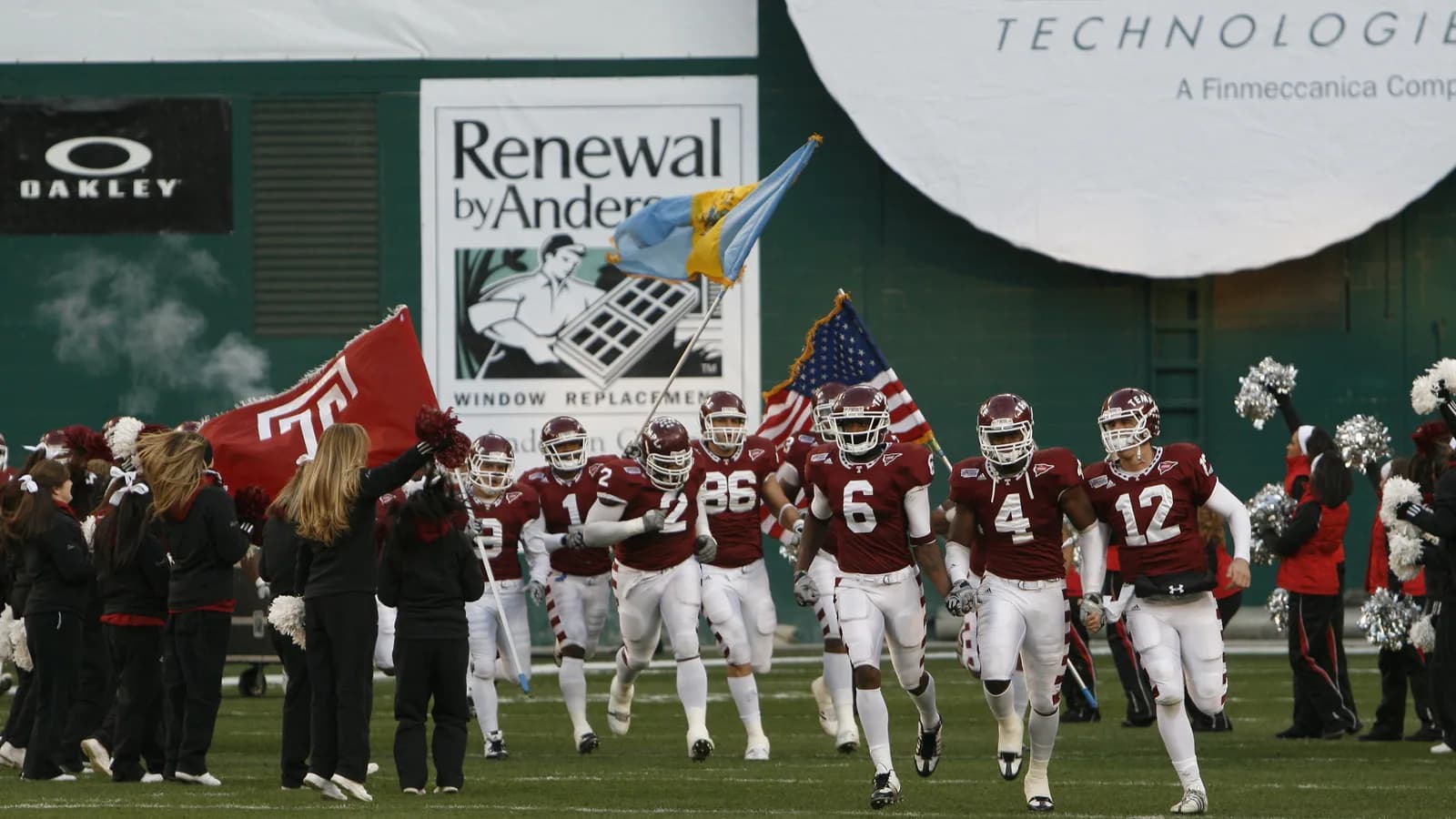
Jamarcus Pierre took an interception back 35 yards for a touchdown, and Tyree Alualu returned another 63 yards for a score. Those two swings helped Temple beat Rhode Island 38-14 and leave Week 1 with a win rather than merely an encouraging offensive afternoon.
Keveun Mason supplied that afternoon’s dependable center with 20 carries, a career-high 158 rushing yards and two touchdowns, plus 34 yards on two catches. Temple now gets to find out how much of that production travels against No. 16 Penn State on Saturday at noon ET on ESPN2.
The memory attached to this matchup is irresistible. In the last Philadelphia meeting, Temple overcame a 10-0 deficit, sacked Penn State 10 times and won 27-10, its first victory in the series since 1941, in front of 69,176 people. But the Owls cannot reproduce 2015 by remembering it. This team needs its own upset mechanism.
Let Mason keep the game on Temple’s terms
The model gives Temple a 6% chance to win. That makes the upset something to savor as a possibility, not something this season must deliver. The useful question is whether the Owls can keep Penn State from turning the afternoon into a succession of short Temple possessions and short fields.
Mason is the best answer Temple has shown. His opener established that he can handle lead-back volume, especially while the quarterback job remains unsettled. It did not settle the whole backfield. Projected first-team back Sam Brown warmed up against Rhode Island but did not play, leaving his availability and Temple’s longer-term workload split unresolved.
Watch whether Temple can build possessions around Mason rather than asking him to rescue obvious passing downs. The Owls already showed two useful versions of sustained offense in the opener, a seven-play, 75-yard touchdown response late in the first half, followed by a 17-play, 82-yard touchdown drive that consumed 8:16 and converted two fourth downs in the third quarter. Against Penn State, drives like the second one would shorten the game, rest Temple’s defense and reduce the number of chances the favorite gets to impose its depth.
That will be considerably harder this week. Penn State held Marshall to 147 total yards, 44 on the ground, and 11 first downs in a 45-0 opener. The Nittany Lions also forced two takeaways. Temple’s offensive line enters the matchup with left tackle Giakoby Hills expected to miss at least six weeks, while guard Kevin Terry and Brown were still described as game-time decisions.
Mason does not need another 158 rushing yards for Temple to stay competitive. He does need to produce positive early-down runs, create manageable third downs and keep the defense from spending the afternoon on the field.
Pressure has to become more than an opening-week flash
Temple held Rhode Island to 97 net rushing yards on 30 attempts while producing six tackles for loss and two sacks. That is promising evidence from the rebuilt defense precisely because run resistance and pressure are the traits that can prevent a heavy favorite from playing comfortably.
The next step is much steeper. Temple cannot count on another pair of interception touchdowns. The defense instead has to force uncomfortable throws, disrupt Penn State’s timing and end possessions before the Nittany Lions reach the end zone.
The 2015 Owls produced their famous result with 10 sacks. This group does not have to imitate that total, but a clean pocket and an orderly Penn State running game would remove Temple’s most plausible source of chaos. Root for the front to make the game physically awkward, and for the secondary to punish the mistakes that follow.
The quarterbacks cannot donate field position
Ajani Sheppard completed 5 of 10 passes for 85 yards in the opener; Jaxon Smolik went 4 of 6 for 57 yards and a touchdown. Neither threw an interception, although Smolik lost a fumble while escaping a sack.
Both quarterbacks moved the ball, but neither claimed the job. K.C. Keeler called the competition ongoing afterward and was not ready to name a starter. Penn State now turns that uncertainty into a field-position concern. One blind-side hit, late throw or mishandled exchange can undo several productive Mason carries.
Smolik brings an obvious personal layer as a former Nittany Lion. He is one of four former Penn State players added by Temple for 2026, along with defensive lineman Kaleb Artis, safety Kolin Dinkins and tight end Joey Schlaffer. Familiarity may sharpen the emotion, but it does not simplify Keeler’s choice. Whether Sheppard, Smolik or both play, Temple needs the position to preserve possessions rather than chase highlight throws.
That is the week’s realistic bargain. If Mason keeps the chains moving, the quarterbacks protect the field, and the rebuilt defense generates pressure or points, Temple can keep the game close long enough for Lincoln Financial Field to feel the possibility. If Penn State wins early downs and Temple starts handing over short fields, nostalgia will have nowhere to go.
The interactive guide shows how narrow Temple’s modeled path is, and the methodology explains how it was built. Mason, the quarterbacks and the rebuilt defense now have to give the old Philadelphia story a new mechanism.