
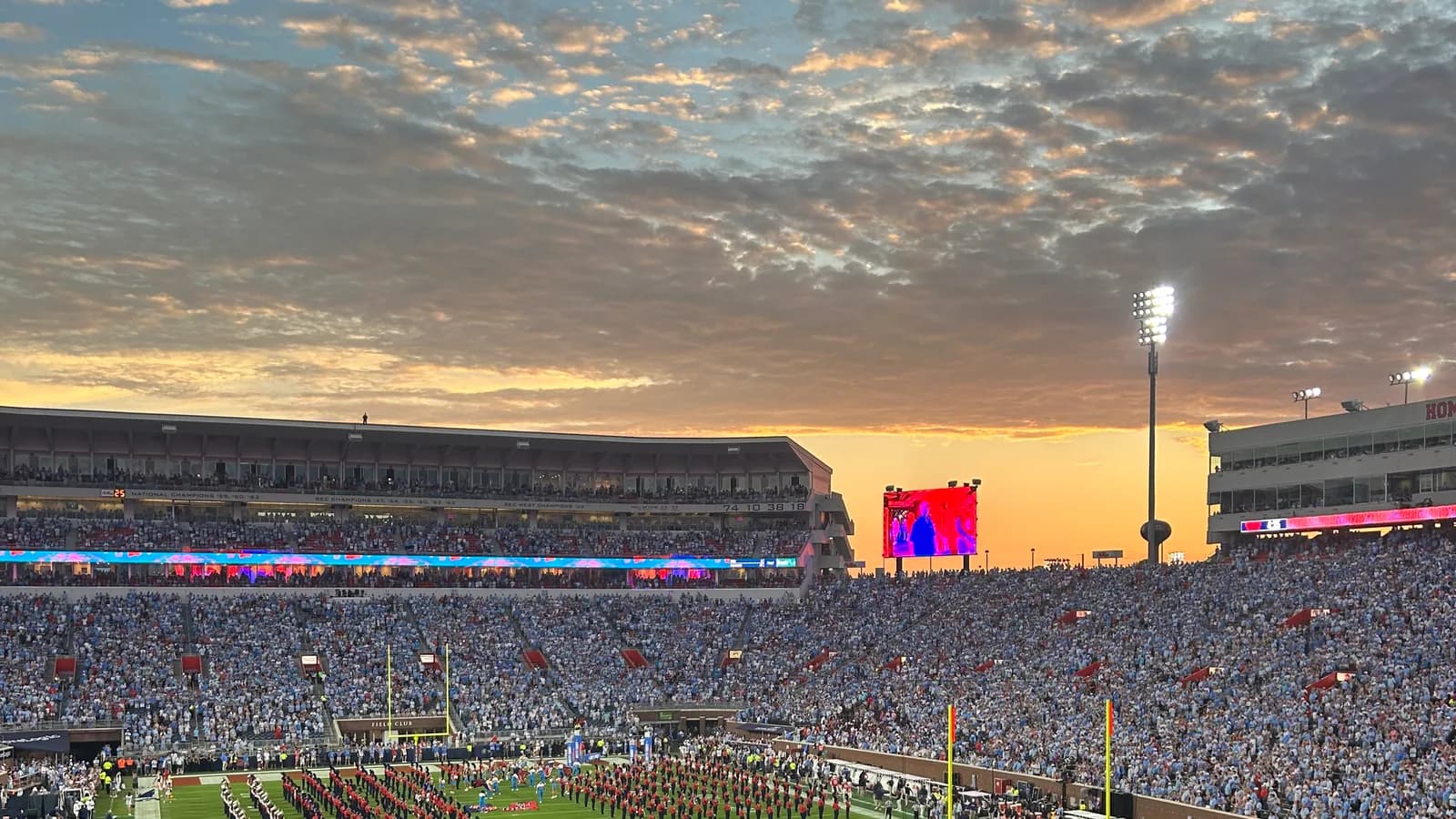
Trinidad Chambliss found Deuce Alexander for two 62-yard touchdowns after halftime, and Ole Miss needed both of them to beat Louisville 41-38. Chambliss finished with 336 passing yards and four total touchdowns, while Alexander turned his first Ole Miss start into five catches for 159 yards. That was an emphatic first answer to the question of whether this offense could remain explosive with a new group of featured receivers.
Coordinator John David Baker deserves a share of the credit. Pete Golding attributed the second-half surge to Baker's adjustments, improved matchup creation and steadier execution from one possession to the next. The two long touchdowns to Alexander came against man coverage, and a 35-yard touchdown to Caleb Odom gave Chambliss another matchup he could punish. Against Charlotte, watch whether Baker can keep Alexander and Odom creating space around Chambliss while sustaining drives instead of relying on another burst of long touchdowns.
Louisville also supplied the warning. The Cardinals gained 386 yards after halftime, even though Kam Franklin, Luke Ferrelli, Blake Purchase and Suntarine Perkins shared Ole Miss's three sacks. The front generated pressure through several players; it did not help the defense sustain control.
Golding gave a more precise diagnosis than “play better.” He traced Louisville's second-half explosives to missed tackles, communication mistakes, poor angles and coverage busts, and he accepted responsibility for asking too much of replacement defensive backs while retaining a multiple scheme. Charlotte is where those assignments need to become visible corrections. That means defenders lined up on time, fewer uncovered targets and routine tackles staying routine.
Charlotte is the rehearsal that matters
Charlotte visits Ole Miss at 6:45 p.m. CT Saturday on ESPN2. The model gives the Rebels a 98.4% chance to win, so suspense over the result would be bad news. Golding pointed to Charlotte's loss to The Citadel and warned that Ole Miss remained too inconsistent, with flashes of elite and bad football.
This is Ole Miss's home opener, and LSU comes to Oxford one week later for the SEC opener. That makes Saturday the only live game before former Ole Miss coach Lane Kiffin returns leading LSU, turning the SEC opener into an immediate test of how Golding's team handles the breakup that reshaped both programs.
Ole Miss should also leave the night with a clearer rotation. Kewan Lacy did not return after leaving the Louisville game, although Golding's initial assessment was that the issue was not serious. Sharif Denson, a starter throughout camp, did not play; Antonio Kite exited early; Keaton Thomas sustained an ankle injury with negative X-rays; and Golding said Tah'j Butler played well in Thomas's place. The score may permit caution with anyone who is not ready, but the defensive backs available for LSU need useful snaps together.
There is no reason to apologize for wanting another batch of Chambliss-to-Alexander fireworks. Just pair it with something Louisville denied Ole Miss, sustained defensive command. Golding called his debut team resilient but far from perfect across all three phases, and he said LSU had not distracted the Rebels during Louisville preparation. Against Charlotte, Ole Miss can show that its resilience includes playing a clean four quarters, but the claim that Kiffin's return is not a distraction will face its real test against LSU.
The 41-38 margin also needs context before it becomes proof that every close-game problem has been solved. A failed Louisville punt snap handed Ole Miss the ball at the 12 before a Lacy touchdown, and a roughing-the-kicker penalty erased a missed 57-yard field-goal try and extended another touchdown drive. Lucas Carneiro still delivered when required, making the winning 48-yarder after an earlier miss, but Ole Miss benefited from swings it cannot plan to receive every week.
The simulation gives Ole Miss a 42.6% playoff probability after a win and 27.5% after a loss, while its first-round-bye probability is 12.2% with a win and 8.2% with a loss. Those figures compare alternative Saturday outcomes. Ole Miss should win comfortably while protecting its playmakers and forcing Charlotte to earn yards against a more organized secondary.
The rest of the board
The outside games carry much smaller stakes. They are worth checking between Ole Miss possessions, not organizing Saturday around.
Eastern Michigan at Michigan State: root for Eastern Michigan
This result carries a 1.4 percentage-point impact on Ole Miss's playoff probability.
Kickoff is 2:30 p.m. CT on BTN. Eastern Michigan has a 25% chance to pull the upset. The simulation gives Ole Miss a 43.4% playoff probability with an Eastern Michigan win and 42.0% with a Michigan State win, a difference tied to the national playoff field with no effect on the SEC standings. It is a fun upset to monitor, not something Ole Miss needs.
Tennessee at Georgia Tech: root for Georgia Tech
Kickoff is 6 p.m. CT on ESPN. Georgia Tech has a 42% chance to win, and the result carries a 1.3-point playoff impact for Ole Miss of 43.1% with a Georgia Tech win versus 41.8% with a Tennessee win. Tennessee losing removes a little national competition from Ole Miss's path; it does not alter the Rebels' conference record.
Navy at Florida Atlantic: root for Navy
The model gives Navy an 82% chance to win.
Kickoff is 6:30 p.m. CT on ESPNU. Navy is the likely helpful result at 81.9%, with a 1.4-point playoff impact. Ole Miss lands at 42.6% if Navy wins and 41.2% if Florida Atlantic wins. The benefit again comes through the national playoff field, with no effect on SEC standings.
The full set of conditional outcomes is available in the interactive Week 2 guide, with the simulation approach explained on the methodology page. Saturday's real payoff, though, will be easy to see without a calculator, with Alexander and Odom still creating explosives, Lacy and the defensive backs moving toward full availability, and Golding's defense making Charlotte earn every yard before LSU changes the temperature in Oxford.