
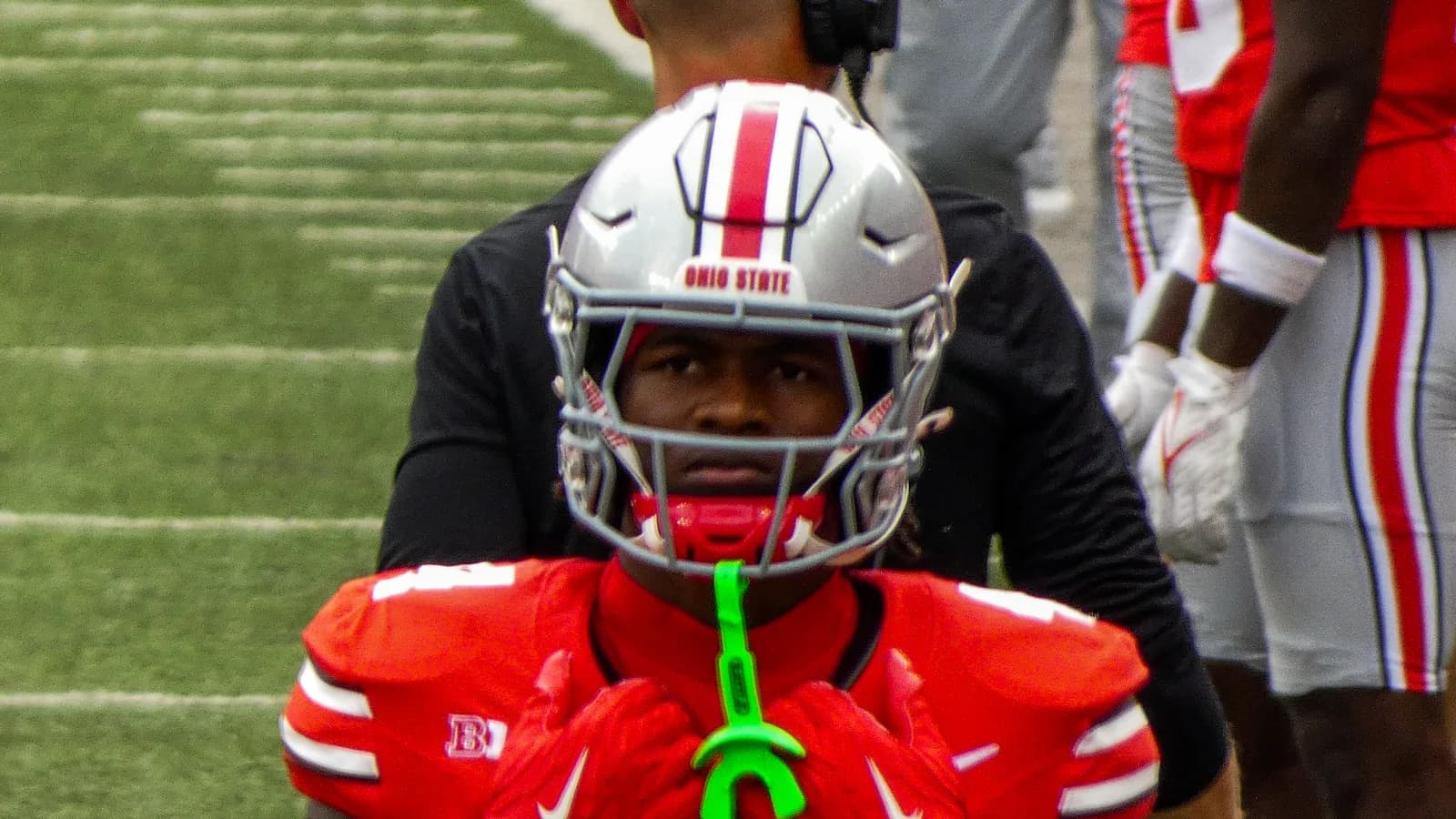
Austin Siereveld moved from right guard to right tackle, and Gabe VanSickle entered beside him at right guard for several first-team drives against Ball State. Ryan Day said afterward that the offensive-line competition remained open. Ohio State won 56-3, but the change showed that the Buckeyes had not found their best five before the game, or during its opening stages.
Arthur Smith and Tyler Bowen found an answer at halftime. Day said they identified the movement in Ball State’s defensive front and adjusted the rushing schemes; Bo Jackson then broke a 65-yard touchdown run, Ja’Kobi Jackson added a 49-yarder, and Ohio State finished with 237 rushing yards. That response matters. It showed that the new offensive staff could diagnose and correct a problem during a game. It did not establish that the Siereveld-VanSickle pairing can give Ohio State the same answer for four quarters in Austin.
No. 1 Ohio State visits No. 4 Texas at 6:30 p.m. Central on ABC with a modeled 49% chance to win. No other game on the national slate materially affects the Buckeyes, so the focus belongs on whether the run game and rebuilt defense can support their established stars in Austin.
Give Sayin and Smith more than one way to win
Julian Sayin completed 21 of 25 passes for 320 yards and three touchdowns without an interception in the opener. Jeremiah Smith caught eight passes for 151 yards and two scores, all before halftime. Ryan Day then held Smith out after the break with Texas approaching. Arthur Smith’s debut therefore preserved the offense’s clearest advantage instead of burying it beneath a new identity.
Texas already knows how dangerous that advantage can be, but last season’s meeting also showed why Ohio State cannot ask the passing game to carry every possession. Texas outgained the Buckeyes 336-203 and held a 166-77 edge in rushing yards, yet Ohio State won 14-7 because Texas went 0-for-2 in the red zone and 1-for-5 on fourth down. The Buckeyes won the downs that changed the score.
Reproducing that result becomes harder if Sayin repeatedly faces obvious passing situations. Watch the right side when Ohio State runs on ordinary first and second downs. Siereveld and VanSickle do not need to produce another pair of breakaway touchdowns, but they do need to prevent Texas from turning every meaningful series into Sayin-to-Smith or bust. A credible rushing option can keep the playbook open and make those decisive third and fourth downs manageable.
The setting raises the cost of every protection error and stalled drive. Texas has won 21 of its past 22 games at DKR-Texas Memorial Stadium. Ohio State has beaten Texas in each of the past two seasons, 28-14 in the January 2025 CFP semifinal and 14-7 in last season’s opener, but this is the first of those three meetings in Austin.
Make the defensive rotation survive real pressure
Matt Patricia’s rebuilt defense allowed Ball State only 165 yards on 60 plays, including 45 rushing yards, and stopped 11 of 14 third-down attempts. That was clean opening evidence, particularly for a unit with new responsibilities throughout the lineup. Texas can force the Buckeyes to prove that the depth displayed in a blowout remains usable when substitutions and communication carry consequences.
John Walker started at defensive tackle, Zion Grady started on the line, and James Smith rotated in for two tackles and a five-yard tackle for loss. Those names now give the interior rebuild some substance. Against Texas, Ohio State needs that group to keep blockers away from the second level and still generate enough disruption for the defense to win the same high-leverage downs that decided last year’s game.
The Longhorns bring more ways to stress those assignments. Arch Manning threw for 305 yards and four touchdowns in Texas’ 59-7 opener, while Ryan Wingo gained 121 receiving yards and Auburn transfer Cam Coleman caught two touchdown passes in his Texas debut. The concern is not simply whether one new Ohio State starter can hold up. Patricia must decide how much of his interior rotation he trusts while Texas threatens different areas of the field.
Freshman usage deserves the same practical reading. Legend Bey produced 74 yards from scrimmage and caught a touchdown against Ball State, while Chris Henry Jr. caught a 15-yard touchdown. Day also said Bey returned two kickoffs he had been instructed to leave alone. Bey’s talent can help Ohio State in Austin, especially if the backfield needs another option, but explosive involvement and dependable responsibility are still separate things.
A major result without a desperate one
Ohio State’s 2025 season ended with a 13-10 loss to Indiana in the Big Ten Championship Game and a 24-14 CFP quarterfinal loss to Miami. Ball State could show whether new combinations had promise; it could not say whether the Buckeyes would finish against an opponent capable of punishing their unsettled spots. Texas can.
The simulation keeps that distinction in perspective. An Ohio State loss leaves its projected playoff probability at 89%, while a win lifts it to 96%. The larger swing is in the projected chance of earning a first-round bye, which is 54% with a loss or 73% with a win. Those are alternative outcomes from the same Week 2 starting point, not steps in a sequence. The full numbers are available in the interactive guide, with the simulation approach explained on the methodology page.
So this game should feel enormous without feeling terminal. Sayin and Jeremiah Smith have already shown Ohio State what it can trust. The satisfying version of Saturday is not merely another spectacular passing line; it is Siereveld and VanSickle helping the run game stay available, the interior rotation remaining functional under Texas pressure, and the Buckeyes arriving at the decisive downs with more than one way to win them.