
Rodney Fields Jr. took the opening handoff as Kansas State’s starting running back and finished with 101 yards and a touchdown on 14 carries. Behind him, three other backs found the end zone. Kansas State beat Nicholls 71-3, and the Wildcats scored six rushing touchdowns while piling up 312 yards on the ground.
Kansas State seized the game immediately. The offense scored on its opening possession, Avery Johnson added another touchdown on the ground, and Brandon White returned a punt 65 yards for a score in the first quarter. After Nicholls produced its lone scoring drive, the Wildcats answered with six consecutive touchdowns.
The domination went deeper than the score. Kansas State gained 559 yards and 34 first downs while converting nine of 11 third downs; Nicholls managed 122 yards, nine first downs and four conversions in 16 tries. The Wildcats used the first game of their three-game opening homestand to establish roles and play clean football before the opposition improved.
That last qualification matters. Sixteen Wildcats made their first Kansas State starts, including 10 players who joined the program this year. A roster with 58 newcomers looked remarkably coordinated for one night, but Nicholls could not tell Kansas State whether that coordination will hold when a defensive front wins collisions and disrupts timing.
Watch what happens before Fields reaches the line
Washington State supplied that kind of resistance for three quarters against Washington. The Cougars held the Huskies to 134 rushing yards, made two fourth-down stops and kept them out of the end zone through three quarters. Washington finally broke through with fourth-quarter touchdown drives of 75 and 68 yards.
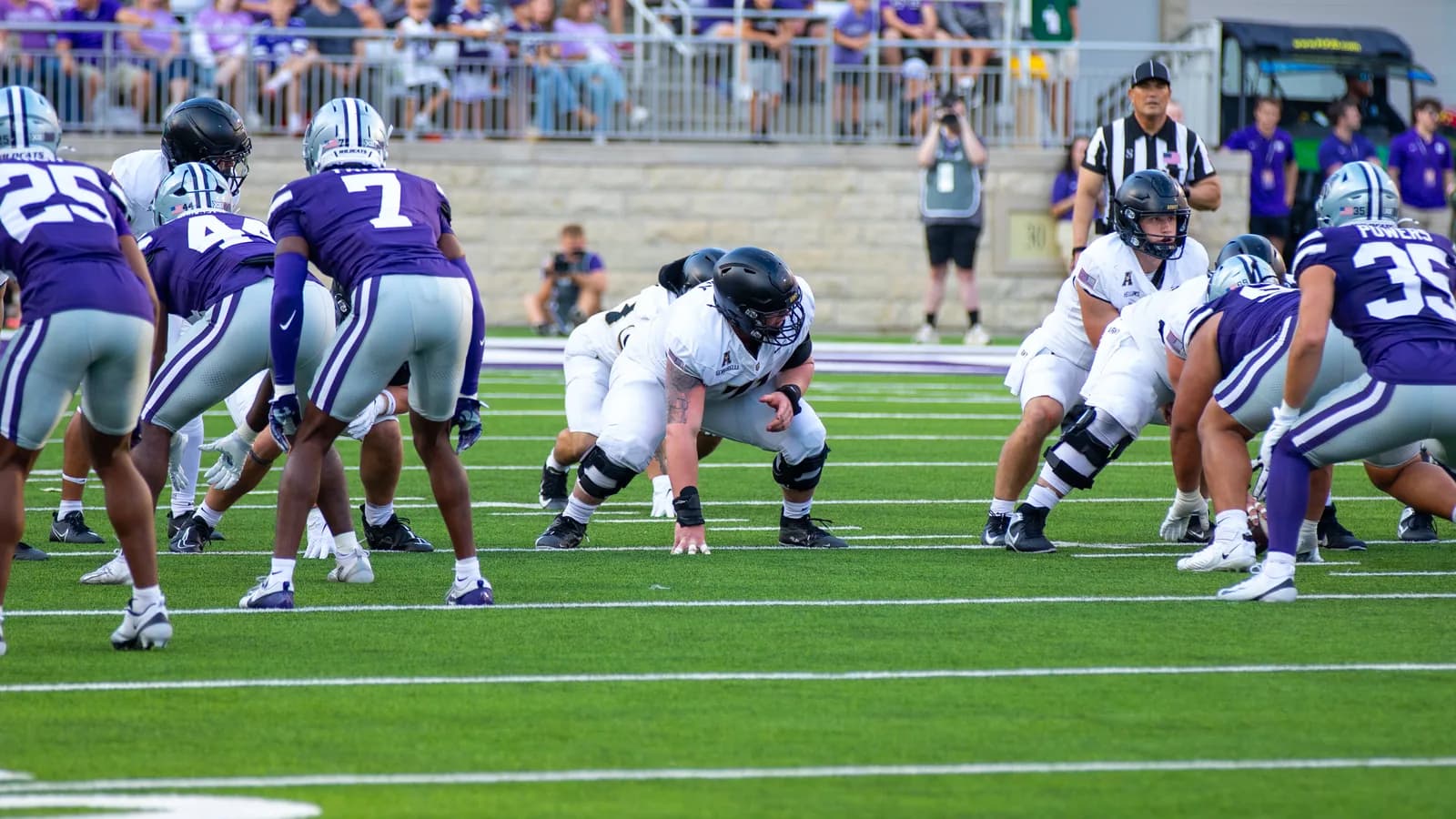
That makes the interior of Kansas State’s offense the part of Saturday’s game worth studying most closely. Keiton Jones, Gus Hawkins, Dylan Villarouel, Ryan Howard and Charlie Adams started against Nicholls, and their line did not allow a sack of Johnson. Now watch whether those five create movement without needing Kansas State to escape immediately to the perimeter. Fields’ best contribution may be turning a blocked gain into an extra two or three yards rather than producing another clean 26-yard touchdown run.
The backfield distribution matters, too. Fields earned the lead role, but Joe Jackson, Jay Harris and Monterrio Elston Jr. all remained involved against Nicholls. If Washington State constricts the early-down run game, Collin Klein can show whether that depth gives him multiple answers or merely more names to rotate through the same clogged lanes.
Klein’s debut as both head coach and play-caller gave fans reason to trust the experiment. Kansas State averaged 7.9 yards per play, converted nine of 11 third downs and spread its scoring among multiple quarterbacks, backs and receivers. Saturday should show how Klein responds when Washington State forces second-and-long, wins at the point of attack or makes Kansas State sustain a drive without an explosive play.
A favorite, with something meaningful to prove
Kansas State and Washington State kick off Saturday at 11 a.m. Central on TNT. The simulation gives the Wildcats a 63% chance to win, which is favorable without making the afternoon feel automatic.
The postseason stakes are modest this early. The Week 2 forecast gives Kansas State a 5% playoff chance and a 12% chance to reach the Big 12 championship game with a win, compared with 3% and 9% with a loss. Winning keeps those possibilities alive, while the performance will say more about whether this rebuilt offense can carry real conference ambitions.
Kansas State’s reconstructed defense also deserves a second look. It held Nicholls to 122 yards and 30 passing yards, and Darien Whitaker forced and recovered a fumble on the unit’s only sack. Washington State quarterback Caden Pinnick presents a different problem because he led the Cougars with 61 rushing yards in his debut. Keeping him contained would extend the defense’s encouraging start without pretending two September games can settle its consistency.
The interactive Kansas State guide places those postseason probabilities in the broader season outlook, and the methodology page explains how the simulation produces them.
The most satisfying version of Saturday is not simply another large rushing total. It is Fields gaining hard yards after contact, the line staying organized after losing an early rep, and Klein finding another call when Washington State finally refuses Kansas State’s first answer.