
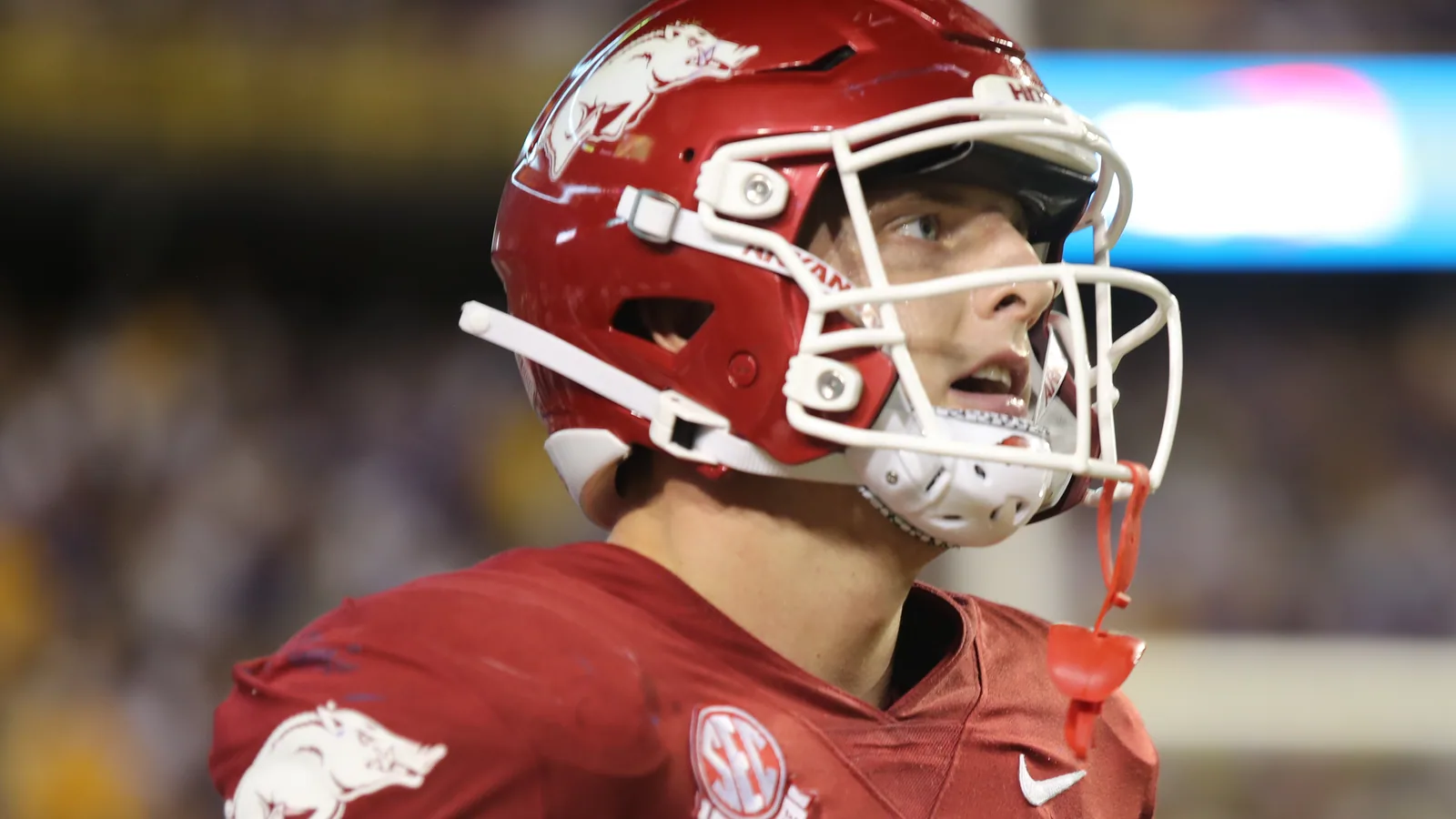
KJ Jackson completed every pass he threw in the third quarter against North Alabama, settling into the game after an interception before halftime. He finished 24-of-35 for 267 yards and three touchdowns, establishing a clear early hold on Arkansas’ quarterback job in a 31-14 win. Arkansas won, ended its 10-game losing streak and reached Week 2 at 1-0.
Jackson also lost a fumble, and Sutton Smith lost another. Those mistakes gave Arkansas three turnovers against an FCS opponent, left the Razorbacks minus-two in turnover margin and produced the game’s only seven points off giveaways. That is the part of the opener that follows Arkansas to No. 20 Utah.
The Razorbacks play at Rice-Eccles Stadium on Saturday at 9:15 p.m. Central on ESPN. The simulation gives them a 12.5% chance to win, so an upset should feel like a real achievement rather than the minimum acceptable result. Arkansas needs to make Utah earn its advantages instead of supplying them with turnovers and short fields.
Jackson and the tackles have to remove the shortcuts
Arkansas did enough well offensively to make the upset path visible. Tim Cramsey’s unit ran 84 plays, gained 415 yards, converted 10 of 17 third downs and held the ball for 41:25. Its final three meaningful scoring possessions traveled 73, 75 and 60 yards, evidence that Jackson can operate patient drives instead of depending on one or two explosive plays.
The trouble was everything that made those drives harder than necessary. Arkansas ran 49 times for 148 net yards, while Braylen Russell, Smith and Jackson each averaged fewer than three yards per carry. Utah can therefore crowd Jackson’s margin for error if the Razorbacks cannot create more useful early-down runs.
Ryan Silverfield’s postgame diagnosis was harsher than the final score. He called it one of the worst offensive performances he had been part of. He said the line failed to recognize run-throughs, cited left-tackle penalties and blamed improper footwork when the right tackle was beaten across his face. Utah will show whether those were correctable first-game breakdowns or problems that stronger personnel can repeatedly exploit.
Jackson needs to take the available completion, identify pressure before the snap and finish possessions with the football. Utah forced turnovers on Idaho’s first two possessions, has intercepted a pass in seven consecutive games and has won the turnover margin in three straight games. Extra possessions would be especially costly because Utah’s offense already has enough ways to stress Arkansas without short fields.
This is not a new problem confined to Silverfield’s debut. Arkansas committed 20 turnovers while gaining only nine in 2025, and opponents outscored the Razorbacks 55-35 off turnovers. A clean game in Salt Lake City would be meaningful progress even if Arkansas cannot finish the upset.
Give the defense a fair chance
Arkansas’ defense supplied the most convincing part of the opener, holding North Alabama to 153 yards, 40 rushing yards and one third-down conversion in 10 attempts. Khmori House, Charlie Collins, Ben Bogle and Bradley Shaw accounted for the unit’s five tackles for loss, while Collins forced the fumble David Oke recovered. That spread of production gives Arkansas something tangible to take on the road.
It does not yet prove that the defense is dependable. Quincy Rhodes Jr. started but recorded only one assisted tackle and no sack, tackle for loss, forced fumble, recovery, breakup or quarterback hurry. The returning anchor can affect a game without filling every column, but Arkansas still needs to learn whether he and the complementary rushers can disrupt a much better offense together.
Utah opened by beating Idaho 66-14 with 633 yards, including 364 on the ground and 269 through the air. Devon Dampier completed 13 of 18 passes for 176 yards, three touchdowns and no interceptions. Arkansas cannot sell out against one phase and expect the other to remain quiet.
That matchup also explains why the turnovers matter so much. If Arkansas’ offense sustains drives and makes Utah cover the length of the field, the defense gets a legitimate opportunity to build on Week 1. If Jackson and the line repeatedly surrender possessions or field position, Utah’s balance can turn an encouraging defensive start into a long night.
Silverfield said the opener did not meet his new staff’s standard despite Arkansas controlling yardage, first downs and possession. That keeps the first win in proportion. It was necessary progress, not proof that the rebuild has skipped its difficult stages.
Those stages differ sharply for Saturday’s two first-year head coaches. Silverfield inherited a team coming off a 2-10 season; Morgan Scalley succeeded Kyle Whittingham after 20 years on Utah’s staff, including 10 as defensive coordinator, and inherited an 11-2 team. Arkansas is building a new operation while Utah is trying to preserve an established one.
No other game has enough impact to pull attention from Arkansas-Utah this week; the interactive guide has the full slate, and the methodology explains the simulation behind the 12.5% upset chance. Against Utah, Jackson’s decisions, the tackles’ recognition and the field position handed to the defense will determine whether the Razorbacks can make a heavy favorite play four quarters instead of helping Utah end the argument early.