
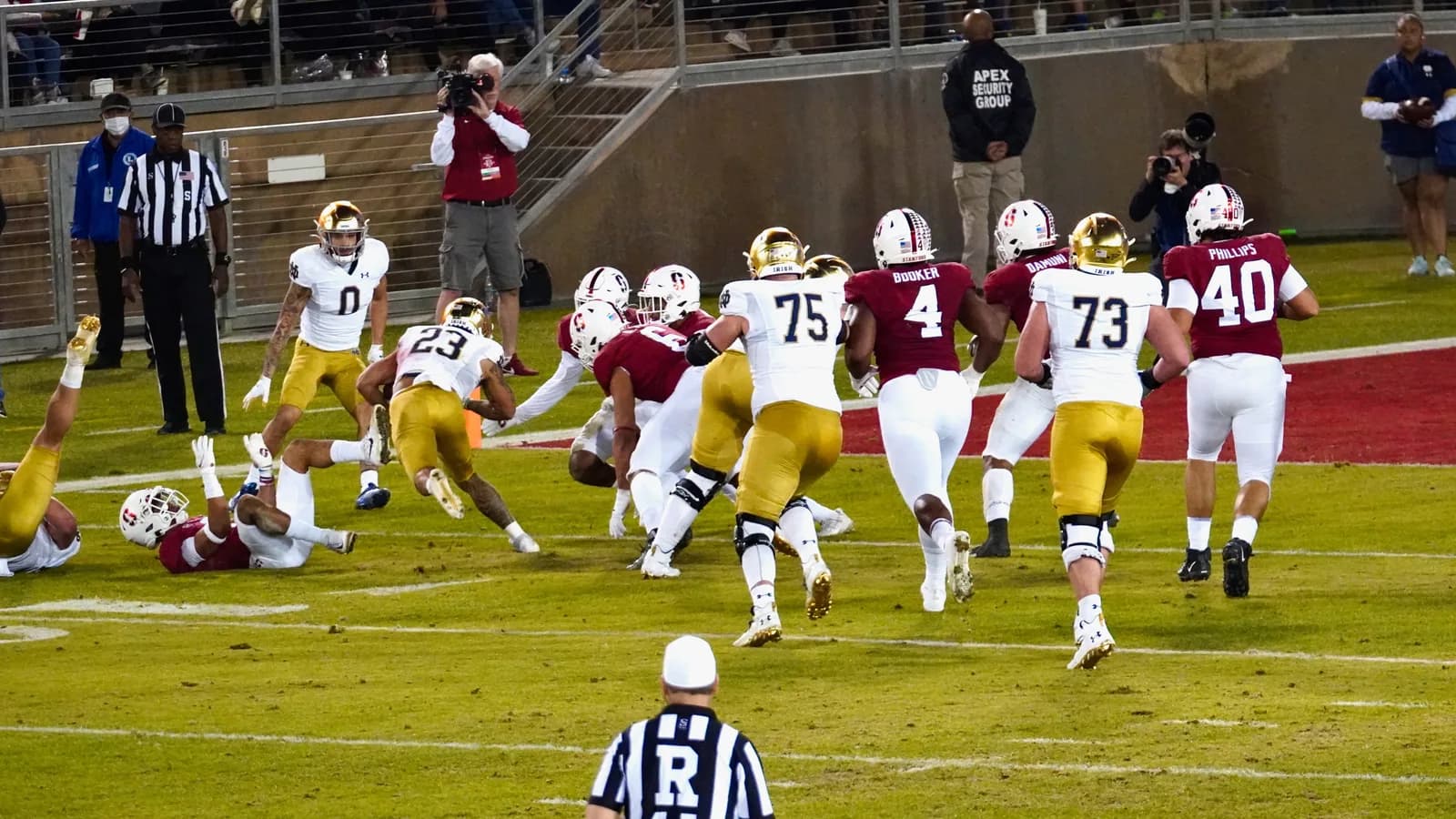
Mark Fletcher Jr. is the memory Stanford has to confront Friday night. He ran for 106 yards and a career-high three touchdowns against the Cardinal last season, turning Miami’s physical advantage into points as a competitive game became a rout.
That is why the most revealing Stanford-Miami action may not come in the opening quarter. The Cardinal were tied 7-7 with the Hurricanes at halftime in 2025. Miami then scored 35 unanswered points, limited Stanford to 2.7 yards per play and won 42-7. Playing even early was not the problem. Holding up after Miami had seen the plan was.
The rematch kicks off Friday at 6 p.m. Pacific at Stanford Stadium on ESPN. The Fan Watch model gives Stanford a 12% chance to win. Treat the upset accordingly. It is a terrific possibility to enjoy, not a fair minimum standard for progress against No. 7 Miami.
What credible resistance looks like
Watch Fletcher before watching the scoreboard. Stanford’s defense wants to set firm edges, account for every gap and prevent explosive plays; those are the foundations defensive coordinator Kris Richard identified for the unit in the spring. Friday provides a wonderfully concrete version of that assignment.
Can Stanford force Fletcher to stop, redirect and earn modest gains? Can the linebackers fit the run without creating easy space elsewhere? Most important, can those answers remain yes deep into the second half?
This is not an invitation to celebrate a respectable final score after Miami takes control. The worthwhile hope is for Stanford to keep making Miami solve the same physical problems for four quarters. Reaching halftime close again would be encouraging only if the Cardinal still control edges and gaps when the game enters its final stretch. Sustained resistance is the point.
There is some reason to believe Stanford Stadium can help. All four Cardinal wins in 2025 came at home, producing Stanford’s first winning home record since 2018, and the 2026 season began with another victory there. That does not erase the talent gap, but it makes home-field resolve more than wishful thinking.
Give the defense somewhere to stand
Stanford’s offense has a role in this physical contest beyond scoring. Long possessions, manageable third downs and a few field-position wins would keep Fletcher from receiving a stream of favorable opportunities. Empty possessions and quick returns to the field would ask the defense to survive Miami’s pressure repeatedly.
There is at least fresh encouragement on that side of the ball. In his Stanford debut, Davis Warren threw for a career-high 310 yards without a turnover, while Micah Ford scored three rushing touchdowns in the 37-27 win over Hawai’i. Miami is a dramatic rise in opposition, so the useful question is not whether Stanford reproduces those numbers. It is whether Warren’s composure and Ford’s finishing power can keep the offense functional when easy answers disappear.
Stanford also enters on a short turnaround. The Miami game comes six days after the Hawai’i victory, while this is Miami’s season opener. The Cardinal have already played through real game situations, but they have had less time to recover and prepare. That tension should temper expectations without draining the fun from the opportunity.
How much hope belongs here
A win would be enormous. It would put Stanford at 2-0, deliver an ACC victory over the conference’s No. 7 team and immediately expand the imaginable range of this season. But at 12%, it is bonus territory, not a result Stanford must produce to make Friday worthwhile.
The more attainable emotional investment belongs in the shape of the game. Hope for Fletcher to meet resistance at the edge. Hope for Stanford’s gaps to remain accounted for after halftime. Hope for the offense to buy the defense rest and make Miami play a sustained road game rather than wait for another avalanche.
The full set of model probabilities is available in the interactive guide, with the simulation approach explained on the methodology page.
Friday does not require Stanford to erase a 35-point second half in one night. It does offer the Cardinal four quarters to show that it cannot simply happen again.