
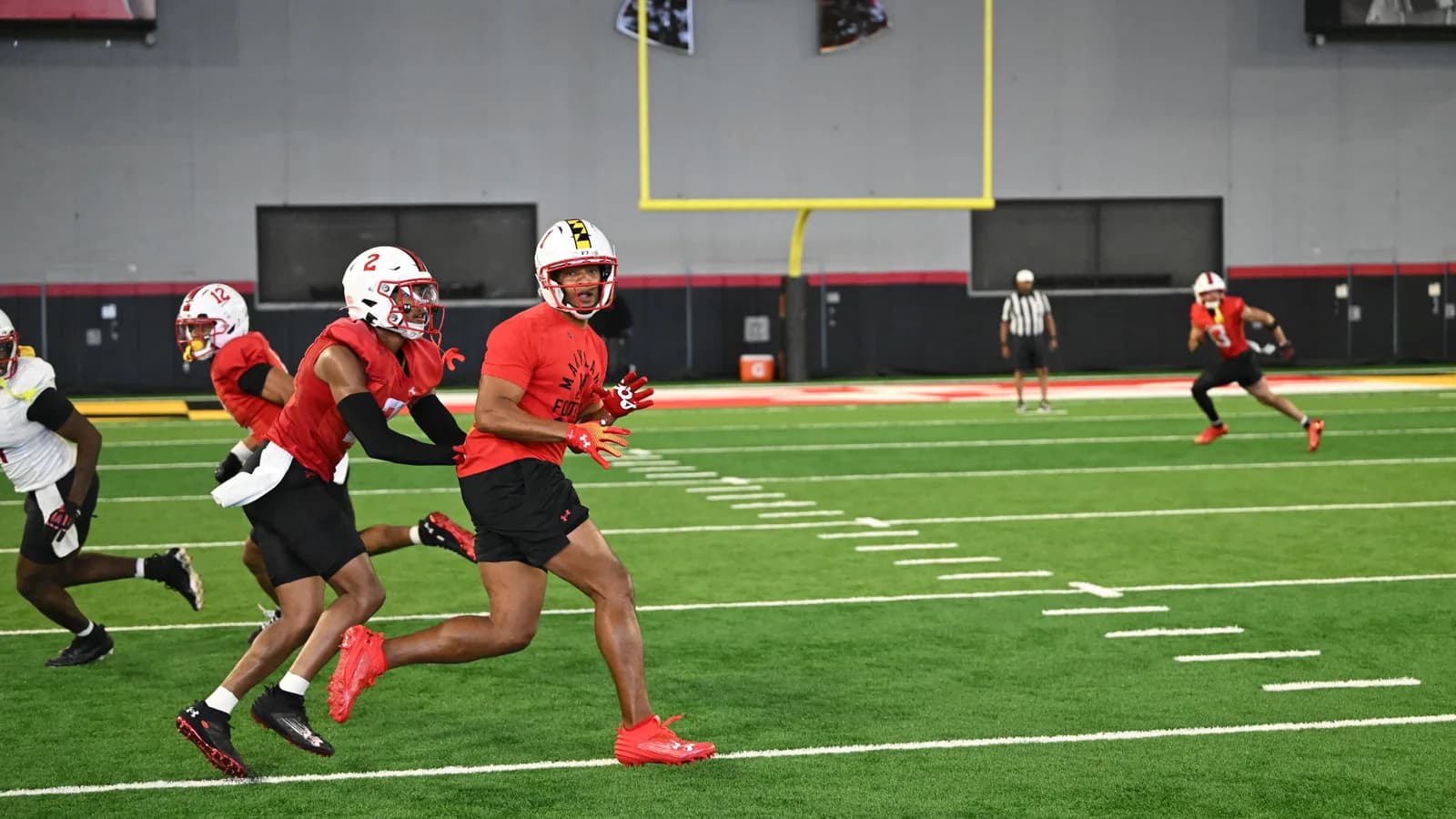
Maryland allowed only nine sacks last season yet averaged 104.3 rushing yards per game and scored nine times on the ground. That is a strange imbalance. The offense protected its quarterback without making defenses consistently respect the run.
Hampton offers about as favorable a first chance to correct it as Maryland could ask for. The Pirates allowed 233.1 rushing yards per game and 5.8 yards per carry in 2025, according to the teams’ cumulative statistics. The Fan Watch model gives Maryland a 99% chance to win Saturday, Sept. 5, at 8 p.m. ET on BTN.
So the useful rooting interest is more specific than a comfortable final margin. Hope Maryland can run efficiently on early downs, stay ahead of the chains and force Hampton to account for Malik Washington as a runner. Raw yardage alone will tell us little against this defense. Repeatable gains before the game gets out of hand would be the more encouraging evidence.
Look for function, not fireworks
The new design should help. With Clint Trickett taking over as offensive coordinator, Maryland plans to play a more aggressive spread offense and use Washington’s running ability more often after simplifying the system during his freshman year, as the program explained in its preseason look at the next chapter.
That does not mean Washington needs to chase a passing total. He already returns with substantial experience after starting all 12 games as a true freshman and setting the Maryland freshman record with 2,963 passing yards. The more revealing sequences will be the ordinary ones involving a back finding space without first contact in the backfield, a quarterback keeper stressing the edge, and Maryland converting a short-yardage snap without needing Washington to rescue it through the air.
There is an important calibration here. Hampton’s weakness makes Maryland’s rushing success expected, not conclusive. A few long runs after the talent gap takes over would be fun but shallow evidence. Sustained early-down control against a defense that struggled to stop the run would begin to suggest that the protection-and-no-production imbalance is actually changing. Failure to create that control would be far more informative, and far more concerning, than an eventual lopsided score could conceal.
A historic night with little modeled suspense
The emotional stakes are different across the field. This is the first football meeting between Maryland and Hampton, and Hampton is playing a Power Four opponent for the first time. That gives the Pirates every reason to bring landmark-game energy even though the model sees little upset risk.
That mismatch between Hampton’s historic occasion and Maryland’s diagnostic one is the best reason to grade the opener narrowly. The broad probabilities remain in the interactive Maryland guide, with their construction explained in the methodology. On the field, Maryland should win; the meaningful hope is that its running game looks functional before the matchup becomes easy.